Luxury houses have spent the past decade borrowing from hotels. Client advisors trained in anticipation, boutiques designed as residences and private salons run on concierge logic all point the same way: the service culture of five-star hospitality has become a reference for luxury retail.
The Luxury & Hospitality Career Index 2026, published on 20 October by Sommet Education and DLG, turns the question around. Rather than asking what luxury wants from hospitality talent, it asks the talent itself. In total, 451 alumni of Les Roches and Glion, ranked second and third respectively in the 2026 QS World University Rankings by Subject for Hospitality & Leisure Management, rated their current employer, named the employers they most want to work for and described where their careers have taken them.
Five results stand out. Read together, they describe a talent pool whose skills luxury houses value, whose employers already offer much of what luxury promises, and which is not yet looking luxury’s way.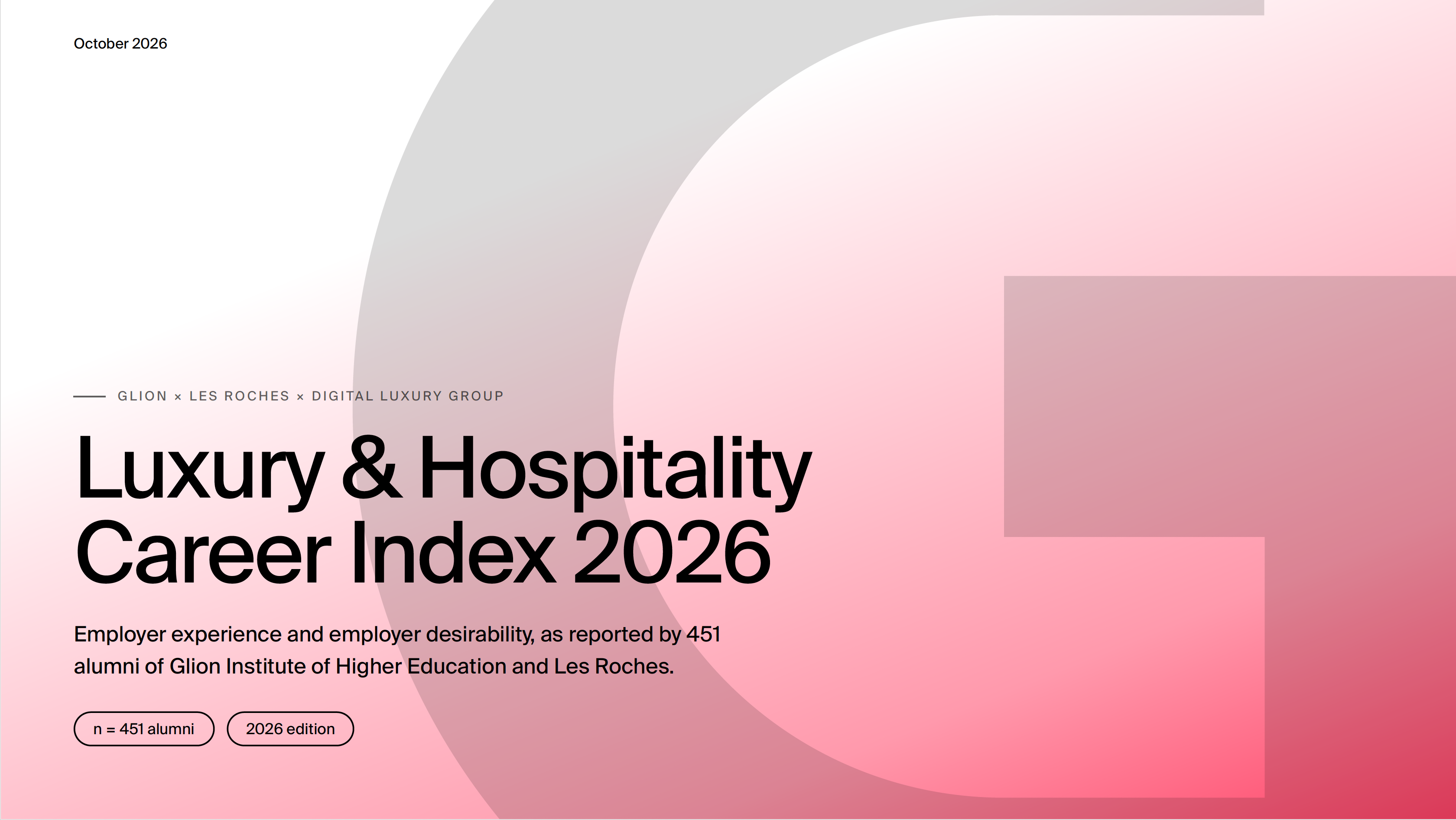
Hotel Groups Still Own the Ambition
Of 669 employer mentions, 65 per cent went to international hotel groups, with Four Seasons, Marriott International, Mandarin Oriental, Aman and Rosewood named most often. Luxury houses account for 8 per cent. On its face, the talent luxury wants to recruit is looking elsewhere.
The figure needs context. Respondents are hospitality alumni, and one of the two questionnaires asked for desirable employers “in hospitality / luxury” while the other named no sector, so the result partly reflects the frame of the question. Even allowing for that, an 8 per cent share suggests luxury houses have yet to present themselves to this audience as a destination rather than a detour.
International, Senior and Well Prepared
The careers behind those answers are substantial. More than half of respondents (53 per cent) work outside their home country, 30 per cent hold senior management or executive roles and 16 per cent are owners or founders. Personal networks are the most common route to a current employer, cited by 37 per cent; only 9 per cent were hired through a school channel.
Alumni also rate their preparation highly. Some 80 per cent say their education prepared them well or extremely well for cross-cultural communication, and 74 per cent for understanding the luxury and hospitality industry.
For employers, the implication is practical. The skills are already in place, and with so few hires made through school channels, presence within alumni networks may matter as much as any formal recruitment pipeline.
Strong on Prestige, Weak on Progression
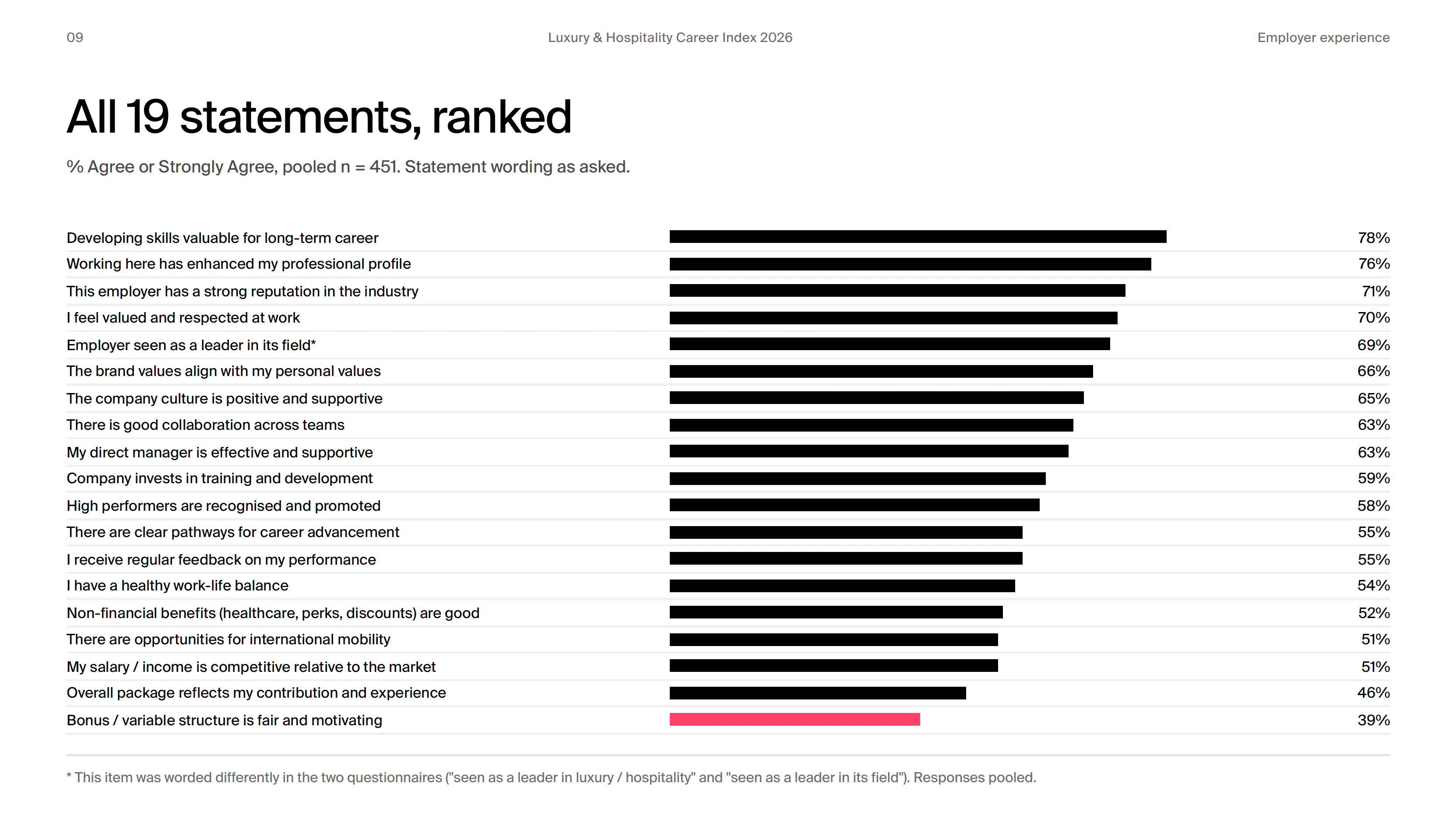
Current employers perform well on reputation. Some 76 per cent of alumni agree that working for their employer has enhanced their professional profile, and 71 per cent that it has a strong reputation in the industry. Prestige is where luxury houses compete most naturally, yet the data suggests hotel groups already deliver it.
The gap opens on progression and pay. Only 55 per cent see clear pathways for career advancement, 51 per cent find their salary competitive and 39 per cent consider the bonus structure fair. Career development is also the factor alumni cite most often when choosing an employer, which places the weakest-rated dimension of their current jobs at the top of their priorities.

An Opening, if Luxury Takes It
For luxury houses, the opportunity is clear but narrow. Prestige alone will not draw this talent away from employers that already provide it; a visible, credible path from client-facing roles into management might. The houses that define that path and make it legible to hospitality alumni are best placed to move beyond an 8 per cent share of ambition.
The open question is structural. Luxury retail careers are often built around boutique networks, and it remains to be seen whether houses can offer advancement on the scale and timeline that hotel groups have taught this generation to expect.
About the study
Commissioned by Sommet Education, conducted by DLG. 451 alumni of Glion Hospitality & Luxury Business Education and Les Roches answered the same online questionnaire between April and August 2026; responses were pooled without weighting. The sample is self-selected, and results describe alumni surveyed, not all graduates. One questionnaire asked for desirable employers “in hospitality / luxury”, the other without a sector. Full methodology in the Index.