How Acqua di Parma Is Navigating a Polarised Fragrance Market Without Losing Its Identity
As prestige fragrance outpaces every other beauty category and niche players multiply, Acqua di Parma CEO Giulio Bergamaschi tells why the brands best placed to endure the moment are those that never chased it.
Luxury fragrance has never been more crowded or more competitive. E-commerce has dismantled the distribution barriers that once kept smaller players at bay, producing an ever-longer tail of niche entrants competing for the same discerning consumer, while the conglomerates recalibrate above them. LVMH’s Perfumes & Cosmetics division posted 3% organic revenue growth in the third quarter of 2024, rising to 4% for the full year. In October 2025, Kering divested its entire beauty portfolio to L’Oréal for €4 billion, a move that made plain how difficult sustained fragrance investment has become outside a structure built around it. The market is polarising: genuine brand equity is being rewarded at the top; everything that cannot justify its price is losing ground.
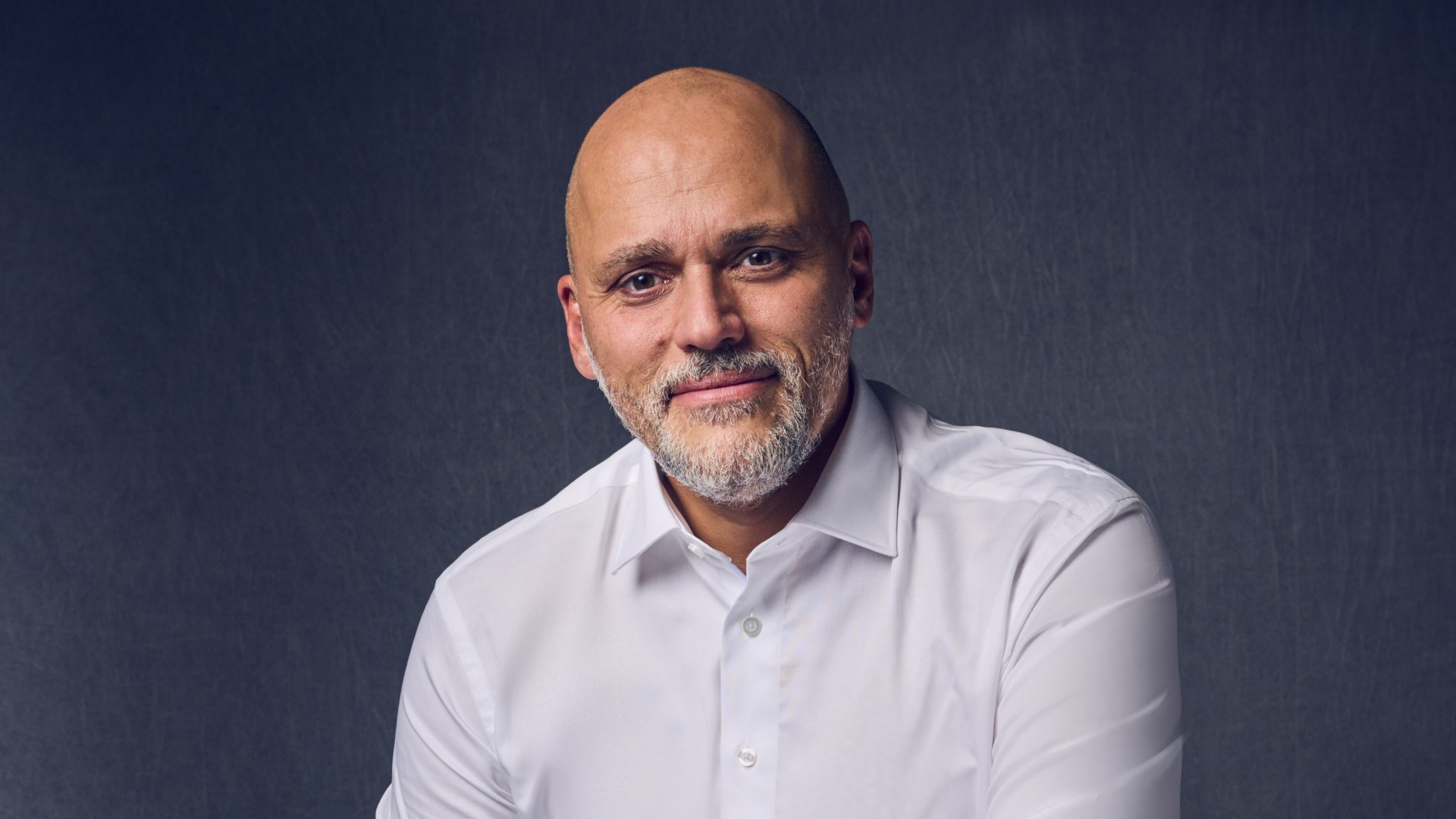
Into that environment steps Giulio Bergamaschi, chief executive of Acqua di Parma, a house marking its 110th anniversary this year. He joined Robin Swithinbank and David Sadigh on The Luxury Society Podcast to argue that for a brand with a genuine identity, a contracting middle market is not a crisis but a clarification.
The market Is Polarising
Bergamaschi’s reading of the current fragrance landscape is candid and precise. Demand remains solid in Europe, the Middle East and the United States, but the dynamic across price brackets has bifurcated sharply. “Consumers and clients are asking either for a costly, original and creative offer, or trading down,” he says. “What we see is a slowing in the bracket of price between €100 and €200. But what is above, and can justify its positioning and its value above, seems not to suffer.”
This pattern finds support in category data. According to Circana, prestige fragrance was the fastest-growing beauty category in the United States in 2024, with dollar sales up 12% year-on-year, accounting for 28% of total prestige beauty spend. The competitive field has expanded considerably, with e-commerce dismantling the distribution barriers that once limited the reach of smaller entrants and enabling an ever-longer tail of niche players to reach consumers directly.
Bergamaschi is sceptical of brands whose strategy amounts to chasing the moment. “All those players very frequently try to surf what is the hype,” he says. “Once you play the outsider and look totally different in year one, if there is no substance [behind it]], it’s difficult to perpetuate the performance in year two – because in year two you’re no longer the new cool kid in town.”
His counterpoint is straightforward: brands should win through heritage rather than ride on hype. “We have the chance of leading a heritage brand, it’s a maison that in 2026 will celebrate 110 years of tradition,” he says. “This has allowed us, since the beginning, to stay above trends and be true to what our values are.” Being Italian, he adds, is a measurable commercial asset: well-understood in established markets like the United States and Europe, and increasingly resonant in newer ones, provided the communication is specific enough to carry the meaning.
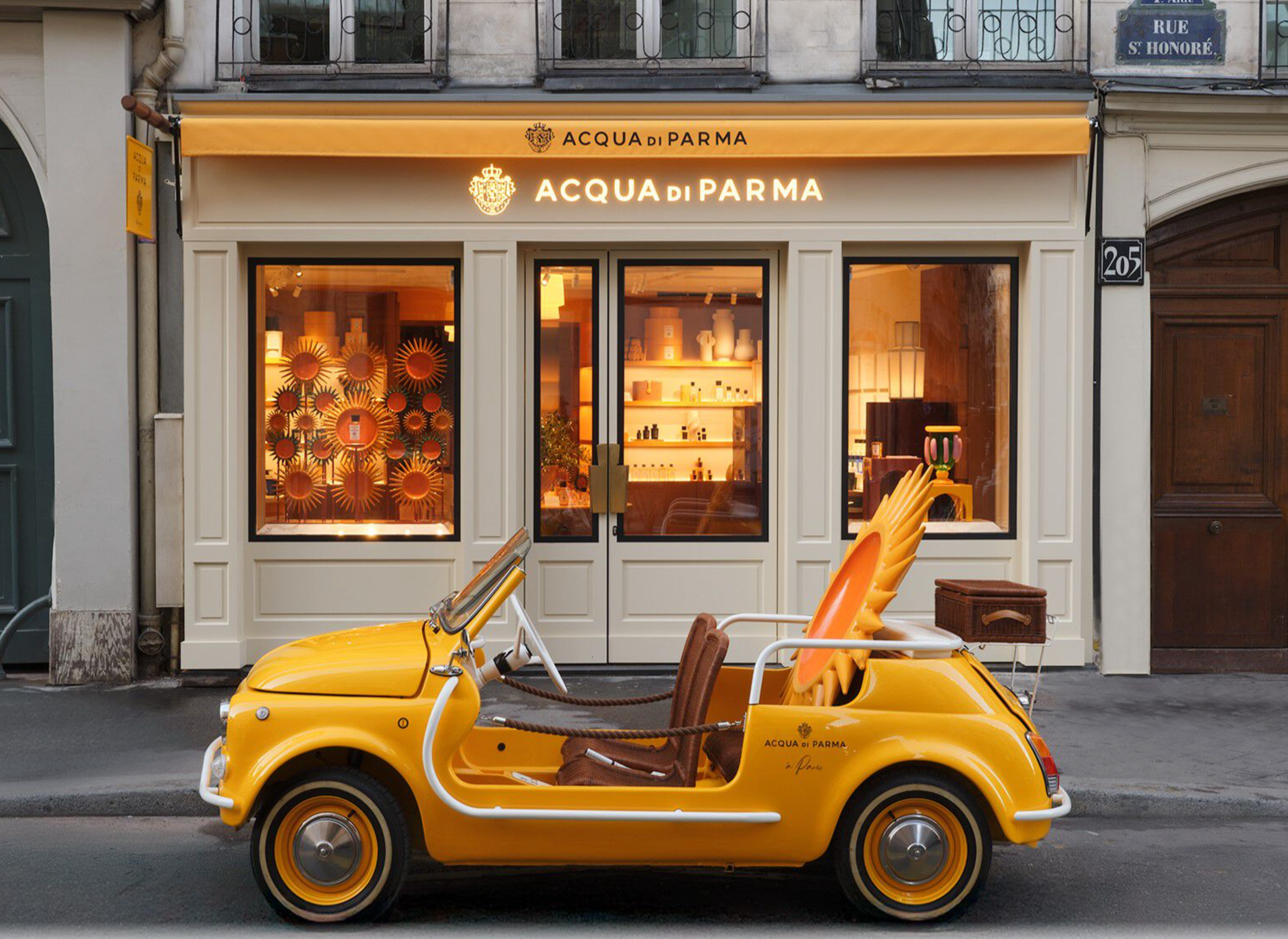
Acqua Di Parma’s boutique in Paris Credit: Acqua Di Parma
The discipline of scarcity
With approximately 1,800 points of sale globally and around 20 boutiques, Acqua di Parma operates at a scale that is intentionally modest relative to the broader selective fragrance market. Bergamaschi is precise about the commercial logic underpinning that restraint.
A brand at Acqua di Parma’s price positioning, he argues, requires a critical density of relevant clientele to justify an in-store experience of any quality. Spreading across 25,000 doors, the footprint of certain competitors, would compromise both the experience and the commercial case for being there. “We could never be capable of affording a higher experience [at that scale]”, he explains, because the potential audience per door becomes too thin to sustain it.
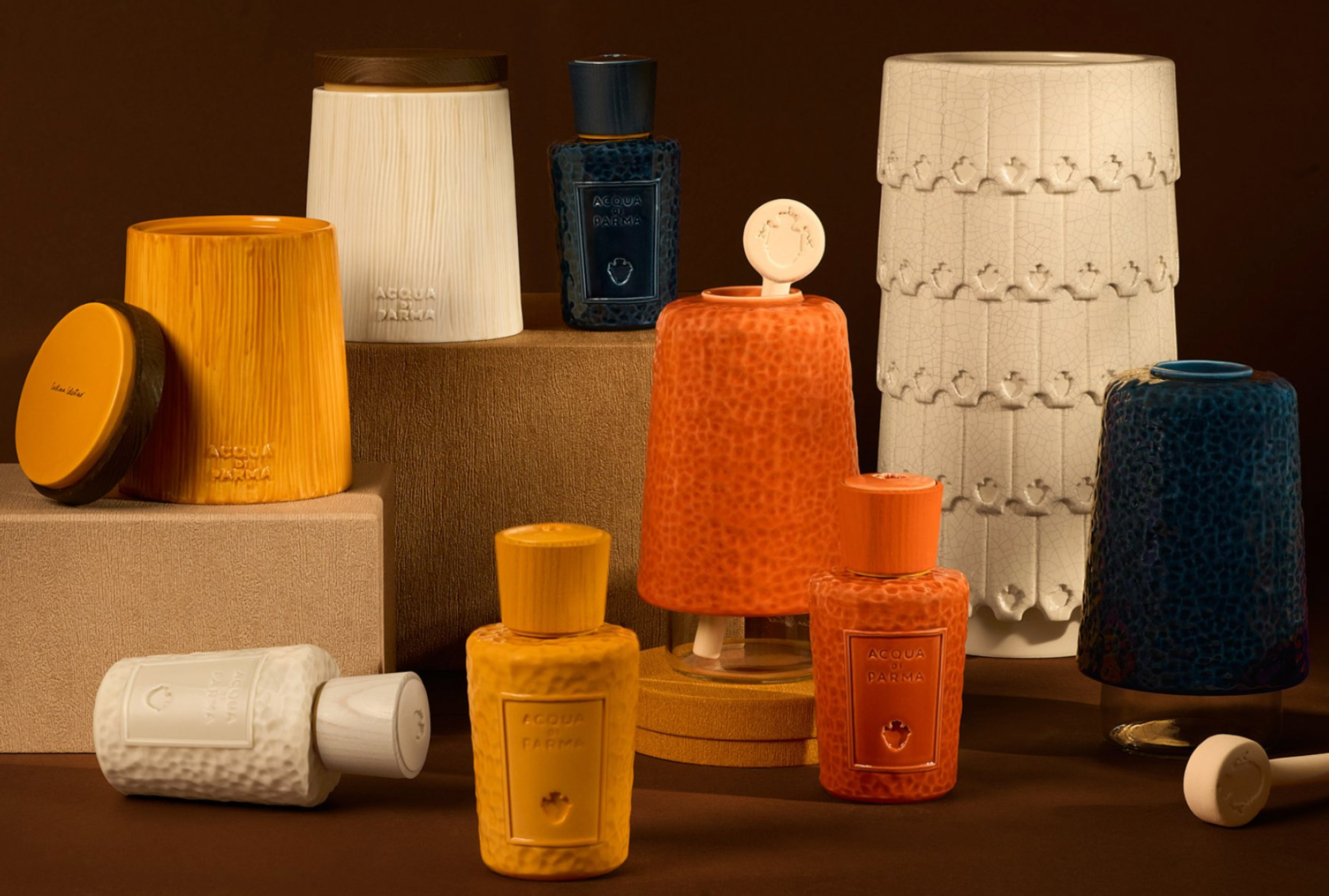
The gifting collection, spanning fragrances, candles, leather goods and homewares, supports the same discipline. It is designed specifically for the brand’s top doors, giving them a wider and more immersive environment rather than pushing volume across the full network. Seasonal collaborations with designers such as Cristina Celestino follow the same principle. “Every time we play with the codes of the house, we find a new superlative in traditional Italian craftsmanship techniques, and we transform them through design to make them surprising and exciting.,” Bergamaschi says. “Their design is always a revisitation of the codes of Acqua di Parma.”
Antelao, Acqua Di Parma’s 2025 Holiday Collection by Cristina Celestino Credit: Acqua Di Parma
Humanism, AI and the China question
On artificial intelligence, Bergamaschi reaches for a historical frame rather than a technological one. “Humanism was a movement that had a big representation in Italy and was putting mankind as a measure of everything,” he says. “I think that a maison like Acqua di Parma needs to walk away as much as it can from standardisation and embrace much more the human and time dimension.”
He is not dismissive of the technology. “There are some tasks that are very repetitive, that are very time consuming. I’m sure AI will help us a great deal on those, so we can better concentrate and focus on what I call the new humanism,” he explains. What he will not entertain is commissioning AI to generate fragrance or brand narrative. “AI can give you more means, but I don’t think AI should replace a human, especially on everything that is creative.”
On China, Bergamaschi’s perspective is shaped by direct experience. He was present in the market from 2013 to 2018, at a point when much of the industry expected the country’s beauty and self-care evolution to follow a mass-market trajectory. It did not. “Generation after generation, new clients surfaced in China, clients that didn’t want to look like the others, and who had more purchasing power and were capable of using online commerce to go beyond the entry barriers of distribution,” he says.
Asia-Pacific is now the fastest-growing regional fragrance market globally, projected to expand at a compound annual rate of 9.5% through to 2030, estimated by Mordor Intelligence. Bergamaschi sees the direction of that growth confirming what he observed first-hand. “We see now clients in China that are more and more demanding, that want to know more and more about what they’re buying,” he says. “They want absolutely to have a different product than their peers, not just to differentiate themselves, but because they have a taste and they like different things. And this is what makes the market much more elevated, exciting and much more demanding.”
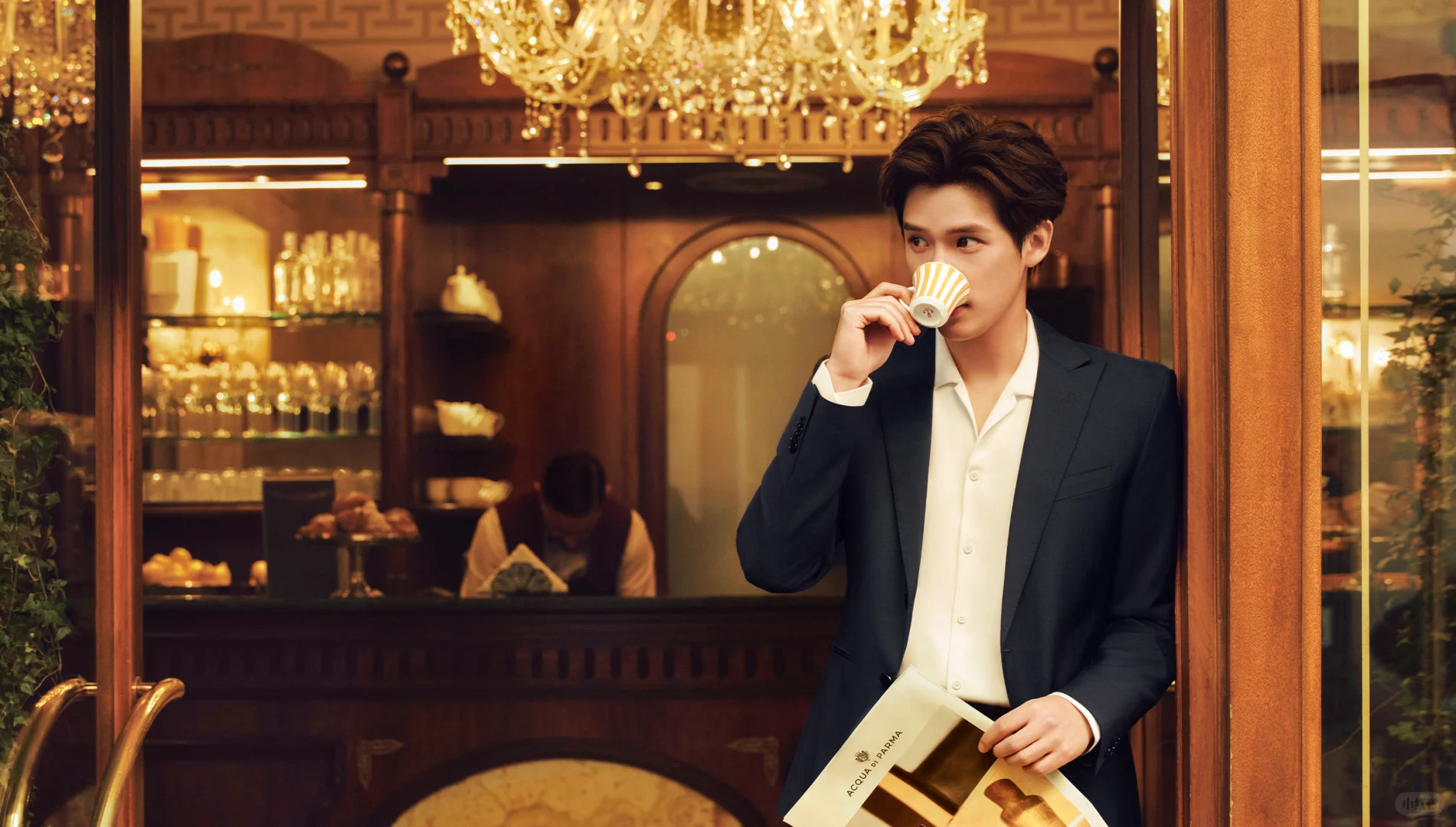
Wang Anyu, Acqua di Parma’s brand ambassador for the house’s 110th anniversary. Credit: Acqua Di Parma
The picture that emerges from this conversation is of a brand that has chosen its constraints carefully and found in them a form of competitive clarity. In a fragrance market that rewards both scale and authenticity but rarely both at once, Acqua di Parma’s wager is that restraint, applied consistently across distribution, communication, technology and the pace of growth, is not a limitation but the condition of long-term relevance.
Subscribe to The Luxury Society Podcast to receive notifications about new episodes featuring luxury industry leaders. Never miss an episode as we continue exploring the themes shaping the future of luxury.
Lydianne is a seasoned marketing and communications professional with over a decade of experience in the luxury industry. Having spent six years in Shanghai, she also has a deep understanding of China’s evolving luxury landscape. Currently Global Marketing & Communications Director at DLG, she previously led marketing efforts for DLG China. Before that, she honed her editorial expertise at Prestige in Singapore and later as China Editor of Luxury Society.
The newly released WeChat Luxury Index examines how high-end and luxury brands achieve marketing or business objectives on WeChat. The report also showcases a ranking of these brands, evaluating whether their offerings and services on WeChat are developed enough to meet the sophisticated demands of today’s consumers.
In an exclusive interview for The Luxury Society Podcast’s inaugural episode, TAG Heuer CEO Antoine Pin reveals how the brand’s historic return to Formula 1 aims to conquer new markets, seduce younger consumers, and win the ultimate battle: The one for our wrists.
Five months into the role, the Swiss watchmaker’s new chief executive explains why price has to be earned, why partnerships are won in the execution and why he sees no reason for pessimism
At Geneva Watch Days, Bulgari’s watch managing director weighs a shrinking unit count against resilient export value, and sets out how creativity, women buyers and a disciplined reading of the secondary market could restore the balance.
At a Geneva Watch Days panel on generative engine optimisation and desirability, DLG’s Senior Advisor Antonio Carriero argued that artificial intelligence cannot originate desire, only mediate it. He explains why GEO should be treated as hygiene rather than strategy, and why the brands that win by 2030 will be both machine-legible and unmistakably human.