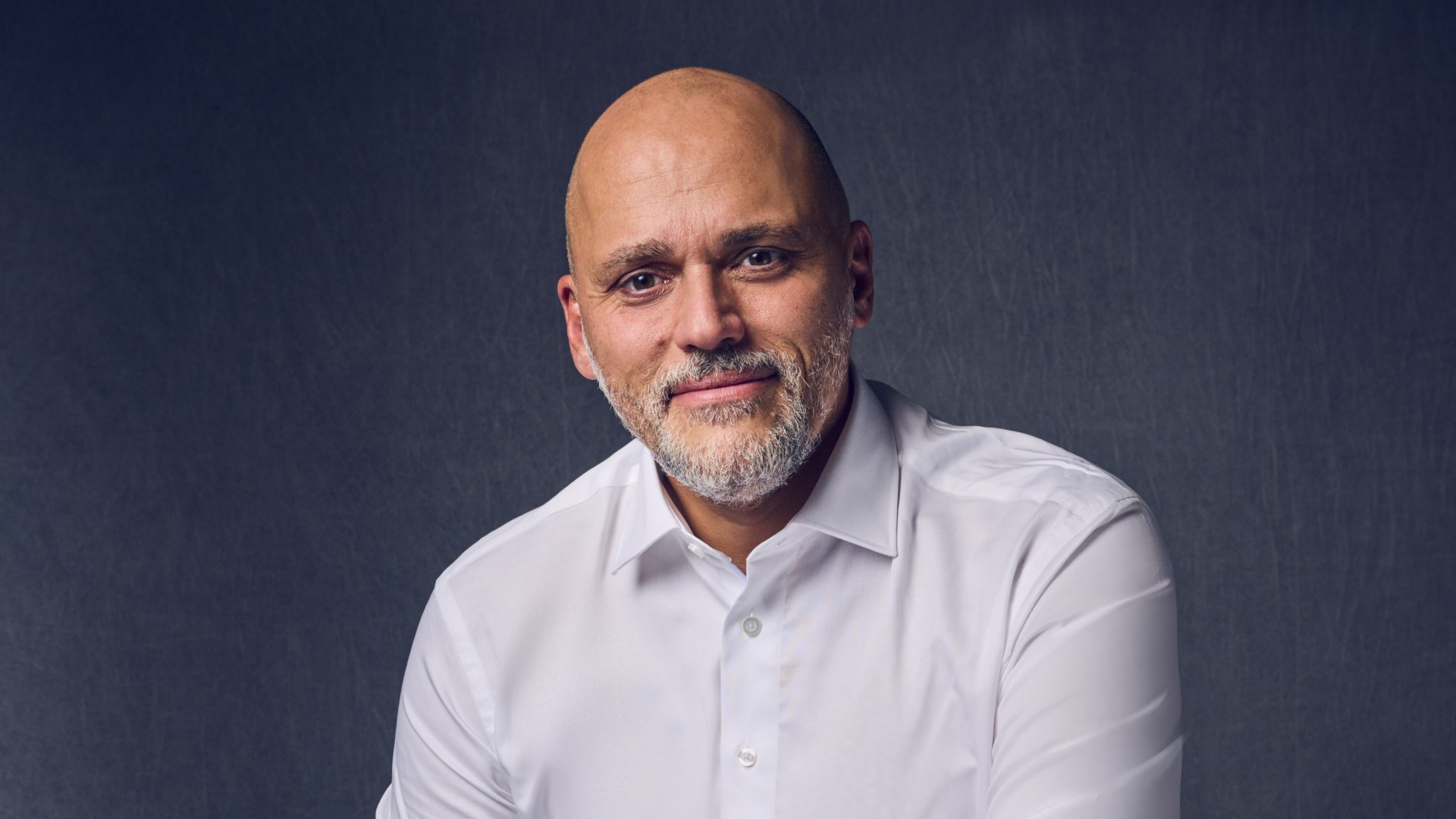
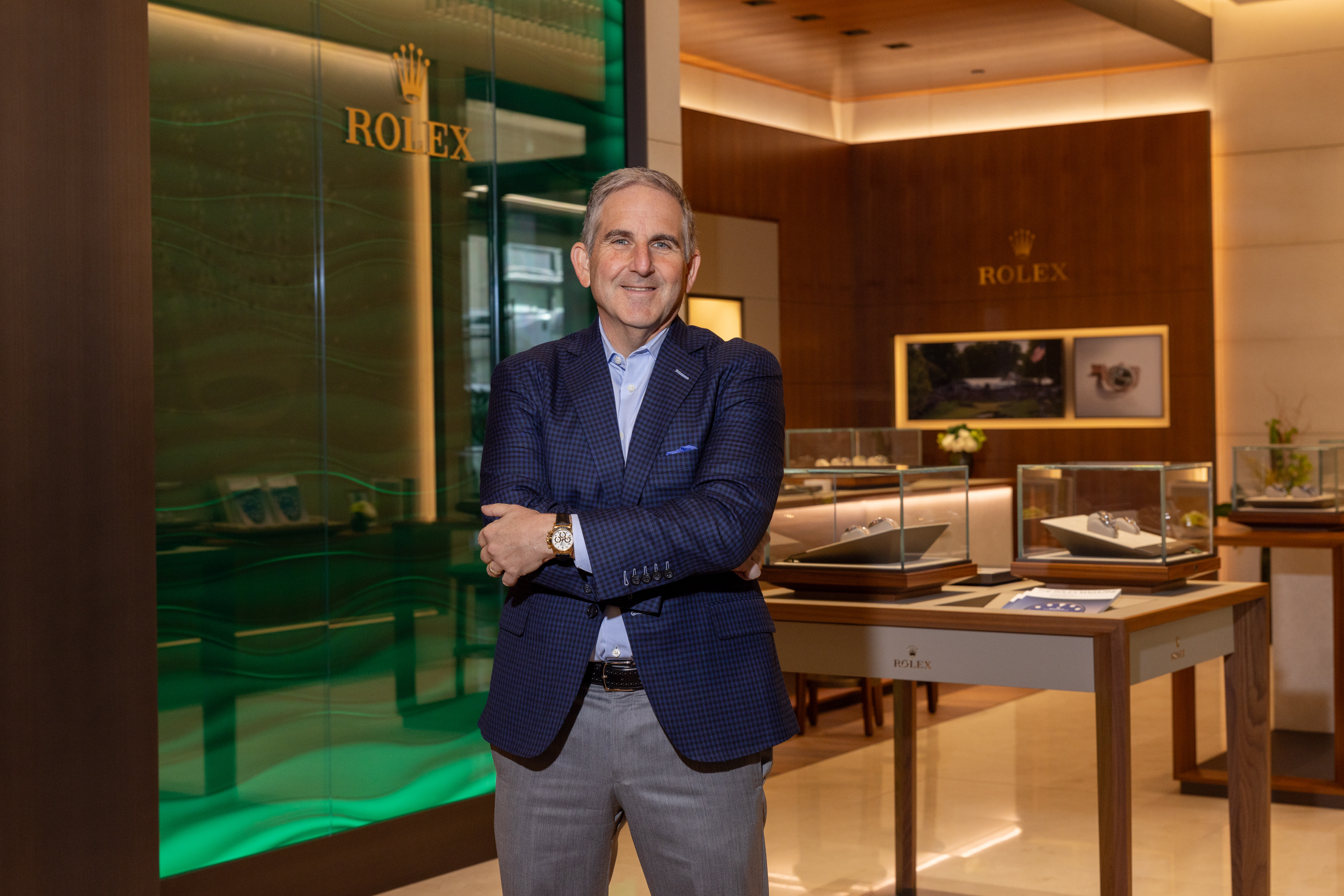
Following the Luxury Society panel AI’s Influence Creep at Geneva Watch Days 2026, hosted by Robin Swithinbank and David Sadigh with panellists Tiffany To, Head of Sale at Phillips, Joe McKenzie, Founder and CEO of Chrono24 UK, and Antonio Carriero, we asked Carriero to expand his argument. Senior Advisor to DLG and one of the most experienced digital executives in luxury, with a career spanning Richemont Group and Breitling SA, he had turned the discussion on stage with a provocative line: artificial intelligence has no taste, that could be interpreted as saying AI does not influence purchasing decisions. Here he explains what he meant.
Luxury Society: On the panel you said that AI has no taste. Some in the room heard that as “AI is not influencing purchasing decisions”. Is that what you meant?
Antonio Carriero: No, and the distinction matters. I did not say AI is not influencing purchasing decisions. It clearly is. When I say AI has no taste, I mean it has no lived relationship with the objects it recommends. It does not wear a watch, inherit one or attach a personal memory to it. But that does not make it neutral. Through the stories it generates, the comparisons it makes and the recommendations it repeats, AI can influence what people discover and come to desire.
The distinction is between experiencing desire and shaping it. AI does not need to experience desire to become a powerful influence on ours.
AI is a statistical map of everybody else’s taste. That map is powerful, it is incomplete, and it is potentially self-reinforcing.
Machines do not desire. But they increasingly influence which human desires become visible. Desirability remains human-originated, but it is now machine-mediated. Ten years ago we would have said it was mediated by GAFA in the West or BAT (Baidu, Alibaba, Tencent) in China. Today the intermediary is an answer engine.
LS: If AI does not create desire, what role does it actually play?
AC: AI is the editor and amplifier of desire. It can co-author the communication, but it does not possess the desire behind it. It simulates taste, aggregates an enormous number of signals and generates persuasive narratives. Those signals still originate in human culture: what watchmakers create, what collectors buy, what experts validate, what communities discuss, what people aspire to. AI decides which of those stories become visible, which brands enter the consideration set and which associations get repeated.
And it is important to understand that AI is not democratic. It is a weighted synthesis. The answer a consumer receives depends on what information is available, what appears authoritative and consistent, what is recent and verifiable, what the system can actually access, and what matches that particular user’s context.
LS: That sounds like it favours the incumbents.
AC: It creates a structural risk, yes. Brands and experts that are already well documented, frequently referenced and digitally accessible can become even more dominant. Meanwhile, an extraordinary independent watchmaker with little structured information about their work may barely appear. AI can reinforce yesterday’s winners.
The consequence is that experts, auction houses and brands need to produce primary, attributable and accurate knowledge, not simply more promotional content. Whoever is absent from the information environment risks being absent from the answer.
And of course the answer will vary depending on the system being used, the sources it can reach, the user’s location and history, and the platform’s own product universe. There is no single neutral AI view of the watch market.
LS: For many executives this feels like it arrived overnight. Did it?
AC: It feels sudden, but it is really the result of thirty years of digital compression. When I started in digital in the mid-1990s, a brand website was essentially a digital brochure. Then digital became a store, through search and e-commerce. Mobile and social turned it into a relationship and influence layer, with algorithms increasingly deciding what people saw and, in doing so, shaping desirability.
Look at the direction of travel. Communication went from brand to consumer, then consumer to consumer, then algorithm to consumer. Brands have had less and less control over desirability at every step. AI is the next step: digital becomes a decision layer. Machine to consumer.
We are moving from links to answers, and ultimately to actions. A consumer will no longer necessarily visit ten websites, read twenty reviews and form a view alone. They will ask one system to interpret the market, compare the alternatives and, increasingly, act on their behalf. That is the real change. An intelligent intermediary now sits between the brand and the potential buyer. It does not simply distribute the brand’s message. It interprets it, compares it and ranks it.
AI has not suddenly created desire. It has dramatically compressed the distance between curiosity and judgment. The challenge for brands is to be accurately understood by machines while losing none of what makes them human.
LS: So what does that mean for GEO? Every agency is now selling it as the new SEO.
AC: The technical foundations of GEO are hygiene: accurate information, accessibility and consistency. But earning a place in the consumer’s consideration set is a strategic issue. What I reject is the idea that optimising for answer engines can substitute for a distinctive product, a credible story and genuine demand. GEO should support brand strategy, not become a substitute for it.
Being discoverable is necessary. Being worth recommending is the real challenge.
Google’s own guidance says there are no special technical requirements for appearing in its generative search experiences beyond sound search fundamentals, and it warns that producing large volumes of content without adding value may breach its spam policies. My reading is simple: AI may drown out average content. I do not believe it will drown out accountable expertise. Generic commentary will be commoditised. Genuine expertise will become more valuable, because AI needs original sources. It can summarise an expert’s judgment, but it cannot retrospectively create decades of scholarship, access, experience or accountability.
LS: During the panel you talked about two languages that content teams must master. Can you expand?
AC: Brands now need to communicate on two levels at once.
For people, they need a compelling human story: why the product exists, why it matters, who created it, what cultural tension it addresses and why a particular association or collaboration is credible.
For machines, they need precision: accurate specifications, materials, provenance, references, pricing, availability, servicing information, and consistent data across their own site, retailers, marketplaces and media partners.
The human story creates meaning. The structured information makes that meaning discoverable and credible. In the past a vague press release might have been enough. In an AI-mediated market, inconsistencies are exposed immediately. A consumer can simply ask: why this ambassador, what is the real connection, how does this watch differ from the previous one, is the price justified? Producing 500 AI-generated versions of a weak story is not a strategy. Brands still need an original point of view.
I would add one caveat. I focus on what brands must do, but brands do not control the narrative, and they control the AI narrative even less. The trade, the platforms, the new intermediaries and the consumers themselves are all links in the AI value chain shaping discoverability.
LS: How are watch buyers actually using these tools today?
AC: At the beginning of the journey, most consumers are trying to reduce risk. What should I buy at this budget? Which brands hold value? Am I overpaying? What is a safe first watch? AI is very effective at reducing the research burden and the fear of making a mistake.
But the final decision in luxury remains emotional. A buyer may use AI to build the shortlist, but they still need to fall in love with the object. So I would say that today AI is stronger at reducing regret than at creating desire.
The next question is how much of the journey consumers will delegate. Research, comparison, arranging an appointment and authorising a purchase are different levels of trust. I expect adoption to progress unevenly across them.
Imagine a watch receiving more online attention while discounting increases and full-price sell-through weakens. Visibility alone would suggest success. The commercial picture would suggest something else. That is why counting mentions in AI answers is not enough: brands need to understand whether those recommendations are creating qualified demand and supporting pricing power.
LS: Is there a downside to AI as a shortlist machine?
AC: There is a dangerous feedback loop. If AI consistently recommends the brands with the strongest resale values, demand concentrates around those brands. Their resale data then becomes even stronger, and the system recommends them again. That produces a flight to sameness.
Good AI guidance must distinguish between the safest financial choice and the most interesting or appropriate watch for you. Those are very different questions, and a watch market that only answers the first one becomes very boring very quickly.
LS: What, then, stays irreducibly human in this category?
AC: When content becomes abundant, judgment becomes scarce. When imagery becomes abundant, authenticity becomes scarce. When recommendations become abundant, accountability becomes scarce.
Watches are a particularly human category. Their value comes from the maker’s hand, the designer’s conviction, the collector’s eye, the specialist’s scholarship, the advisor’s relationship and the memories the owner attaches to the object.
AI is very good at synthesising consensus. Luxury often begins when a human being has the courage to defy consensus. A model trained in the past can identify what resembles previous success. It is far less equipped to take the cultural and commercial risk required to create the next exception. AI can contribute to the creative process. But deciding what a maison should stand for, committing to that direction and accepting the consequences remain leadership responsibilities. It can augment the watchmaker, the specialist, the auction house, the retailer and the collector. But it cannot assume responsibility, develop genuine conviction or attach a life experience to an object. Luxury is ultimately a transfer of conviction from one human being to another.
LS: Alongside your executive career, you advise DLG. What interests you about its approach, particularly in the context of AI?
AC: What interests me about DLG is the discipline behind the intelligence: consistently collecting, structuring and interpreting signals from the luxury market. AI makes that accumulated knowledge easier to interrogate, but the underlying value comes from the data, its context and the people who understand it.
The important questions are commercial. Is attention translating into demand? Are we building pricing power or simply generating visibility? Which products are gaining relevance, with which consumers, and in which markets?
The ambition I find compelling in LuxuryIQ is to bring those signals together so that leaders can make better-informed decisions. Not to replace their judgment, but to give that judgment a stronger evidence base.
How a brand appears in an answer engine is one of those questions. It is not the most important. Is the desire for your brand rising, or only your visibility? Is the premium on your icons holding? Who is taking your share of attention in Shanghai? Did the new ambassador move anything? Most houses still answer these with sell-in figures and instinct, at the moment the market has become measurable.
My role is to advise the leadership team on strategy and to work on a handful of initiatives, LuxuryIQ chief among them. After almost three decades in the room where those decisions get made, I know how much better they could be with a proper map on the table. That, in one sentence, is the work.
LS: Take us to 2030.
AC: By 2030, or earlier, I expect AI to be the consumer’s always-on watch advisor. Or, more precisely, the consumer’s always-on advisor for whatever category they care about.
It may know their wrist size, current collection, budget, style, preferences, service history, upcoming occasions and tolerance for depreciation. It will monitor launches and the secondary market, compare prices and provenance, simulate how a watch looks on the wrist, identify gaps in the collection, arrange appointments and potentially negotiate a purchase or a trade. A full, multi-agent activation.
Brands and retailers will have their own agents providing verified information on products, inventory, servicing and availability. Part of the customer journey therefore becomes agent-to-agent. The strategic competition will increasingly be for inclusion in the consumer agent’s consideration set.
LS: Does that concentrate the market further, or open it up?
AC: It could go either way. It might reinforce concentration around familiar, liquid, well-documented brands. Or, if these systems are designed for discovery rather than pure optimisation, they could help exceptional independent watchmakers reach buyers who would never previously have encountered them.
I also expect the market to divide more clearly into two layers. A highly transparent, AI-mediated layer where price, data, convenience and liquidity dominate. And a deliberately high-touch layer where access, craft, community, human advice and experience become more valuable.
These are not necessarily two different customers. The same collector may use AI to research the market and then want a specialist to explain why a particular watch matters. With the consumer’s permission, an agent may handle the comparison and administration; the human relationship can concentrate on judgment, confidence and the pleasure of discovery.
The winners will not choose between technology and human experience. They will connect the two. The winners will be the brands that are both machine-legible and unmistakably human. By 2030, AI may decide what is visible and credible. Humans will still decide what is worth desiring.
__________
Antonio Carriero is Senior Advisor to Digital Luxury Group. He brings extensive experience in digital transformation, technology and e-commerce growth across the luxury and consumer goods sectors, including senior roles at Richemont Group and Breitling SA.