India’s Titan: The Watchmaker That Wants to Rewrite the Rules of Luxury
As Swiss watch exports contract and the mid-range empties out, an Indian giant with 200 million watches sold and a $46,000 tourbillon in its portfolio is quietly assembling a case that the establishment may find difficult to dismiss.
There is a 1995 newspaper advertisement that C K Venkataraman, outgoing managing director of Titan Company, can recall word for word. The headline reads: “History has it that the Swiss make the world’s finest watches. Now, geography defies history.” Three decades on, the provocation feels less like marketing copy and more like a founding charter.
In a previous episode of The Luxury Society Podcast, co-hosts Robin Swithinbank and David Sadigh, Founder and CEO of DLG, sit down with Venkataraman to examine one of the most intriguing questions in the watch industry today: can an Indian company mount a credible challenge to the Swiss establishment? Titan, born in 1984 to bring international-quality watches to India, now a $6.5 billion business selling 17 million pieces a year and as embedded in Indian life as Casio or Swatch in the West — has arrived at what Venkataraman describes as a pivotal inflection point.
The Opportunity
India is undergoing a generational wealth shift. According to Standard Chartered, the country’s per capita GDP is forecast to grow by nearly 70% to around $4,000 by 2030. Meanwhile, Franklin Templeton’s Beyond Necessities: India’s Affluence-Driven Growth report projects that upper-middle-income and affluent households will reach nearly 24% of the population by 2035, up from 11.1% in 2010 — meaning roughly one in four households will have meaningful discretionary spending power within the decade. As this affluent class expands, it is set to accelerate growth across the luxury sector, with the watch industry poised to be a key beneficiary.
For Titan, this is not an abstract macroeconomic development — it is the direct tailwind behind a premiumisation strategy that has been gathering momentum for several years. “Households in these two income segments [elites and affluent] are expected to more than double in this decade,” Venkataraman explains, “driving the growth in per capita GDP to a disproportionate extent.” The consequence for the watch market is already measurable: the category above $1,000 is growing at nearly triple the rate of the affordable watch segment in India. Yet Titan’s share in the $1,000–$6,000 band — a tier that encompasses Longines, Rado, and Frédérique Constant — remains at a low single-digit figure. The company has the brand equity, the distribution infrastructure of more than 3,200 stores in India, and a customer database drawn from over 200 million watches sold. “The opportunity for bridge to luxury, which is 2,500 to 6,000 US dollars, is exploding in India,” Venkataraman says.
The backdrop makes the timing apposite. According to the Federation of the Swiss Watch Industry, Swiss watch exports declined for a second consecutive year, falling 1.7% to CHF 25.6 billion in 2025, while volumes dropped 4.8% to 14.6 million pieces, extending a long-term downward trend. The contraction remains uneven across segments. While demand at the high end has shown relative resilience, lower-priced watches continued to decline, reinforcing the industry’s shift towards a high-value, lower-volume model. Against this backdrop, exports to India grew 35% over two years, signalling the country’s momentum even as the broader industry faces headwinds.
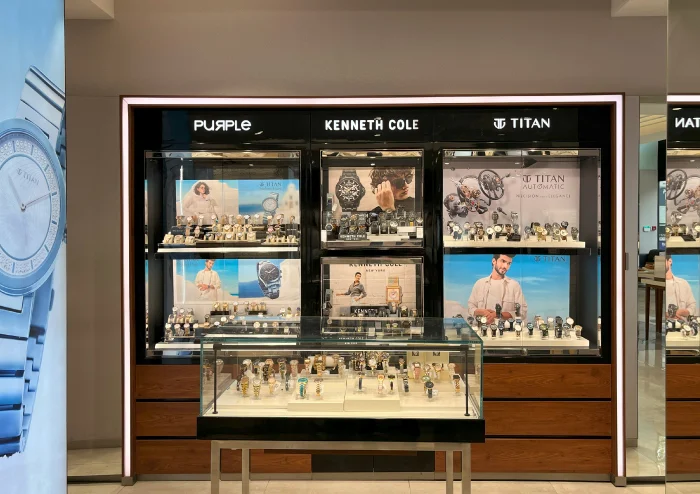
Titan Store in India Credit: Titan Company
The Product as Proof
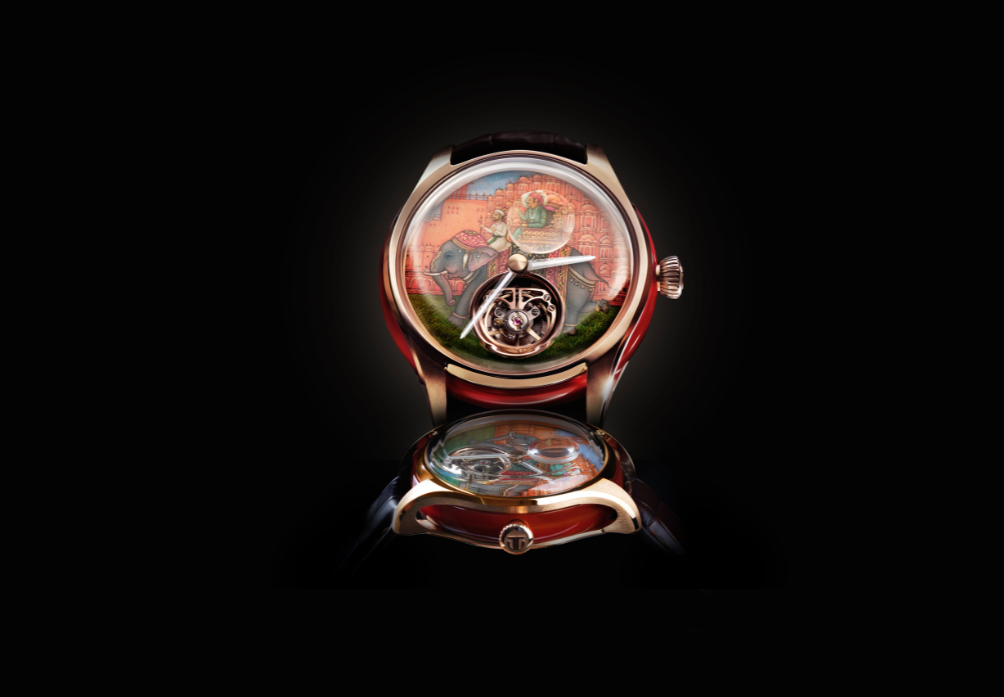
Titan’s premiumisation argument does not rest on aspiration alone. The company is building its case watch by watch: from the Edge, the 3.5mm piece it launched in 2002 and markets as the world’s slimmest watch, and which remains a bestseller today; to the recently introduced Wandering Hours, priced at $2,000; to the Nebula Jalsa, a $46,000 tourbillon featuring an 18-karat rose gold case with a red agate case middle, a marble dial hand-painted by Indian artist Padma Shri Shakir Ali, and an in-house calibre — made in a limited edition of ten pieces.
For Venkataraman, the Jalsa’s value is not measured in units. “The first and most important thing is breaking of the mental barrier in the organisation,” he says. The project required an 18-month sprint through entirely new territory: tourbillon mechanics, high-end case and bracelet finishing, and a submission to the Grand Prix d’Horlogerie de Genève. “It’s like a north star, which will just pull us and accelerate our journey in lifting our standards dramatically,” he reflects.
The morning of the podcast recording brought its own sharp illustration: Venkataraman discovered that a Swiss wandering hours complication of similar visual appearance retails for $50,000–$55,000. Titan’s version is $2,000. “Surely there would be a difference in quality,” he acknowledges freely — but the value proposition is unmistakable. “We are choosing to operate in what we believe is a very sweet spot, which is 1,000 up to 6,000 US dollars. That delivers such exceptional innovation, design, material, quality performance, that it’s a knockout.”
The early evidence from Dubai points to a dynamic that Titan is betting on across its international markets. The company has held a retail presence in the Gulf for some years, but the profile of its buyers has shifted markedly. “In some parts of Dubai, 50% of the customers are not Indian,” Venkataraman observes. “They’re Arabs, they’re European, they’re Russians and Chinese.” That non-Indian buyers are choosing a brand they had never previously encountered — and that owners of Rolexes and Omegas are purchasing Titan’s Stellar at $1,500 — illustrates the logic Titan is applying to skepticism about the “made in India” proposition. “When people — the most discriminating people, people who buy luxury brands — when they actually pick up any one of these pieces that we are currently making and selling, the perception dramatically alters,” Venkataraman says.
Jalsa By Nebula Tourbillon Watch Credit: Titan Company
The Roadmap
For all the international signals, Venkataraman is clear about sequencing. The domestic bridge-to-luxury segment is the priority for the next five years. India’s retail network, combined with an omnichannel platform in which online now accounts for roughly 20% of watch sales, gives Titan a distribution foundation that most international challengers would struggle to replicate from scratch. Dubai and Singapore are being developed from diaspora-focused outposts into genuine premium retail beachheads. Europe and the United States are expressly not on the near-term watch agenda.
David Sadigh draws a parallel with the logic that Chinese brands have followed — building domestic scale and margin before moving outward — and it is one Venkataraman does not reject. What distinguishes Titan’s situation is the dual-track nature of its internationalisation: while the watch business consolidates at home, Tanishq, Titan’s jewellery brand, is on a trajectory that Venkataraman projects could reach $300–$400 million in US sales within five years, establishing the financial and logistical footprint that could, in due course, carry the watches into those markets. As Titan’s Tata parent group reported revenues of $180 billion last year, the resource question is not the limiting factor. “The most important thing in this is that dream and that daring,” Venkataraman reflects, “and then money is more easily gotten frankly.”
The Nebula Jalsa is small in volume but large in signal. Whether Titan can move from beloved domestic brand to credible global luxury player remains a chapter yet to be written, but in Bangalore, the ingredients are quietly assembling.
__________
Listen to the full conversation with C K Venkataraman on The Luxury Society Podcast, available now onApple,Spotify, and all major podcast platforms.
For more perspectives on the shifting dynamics of Swiss watchmaking, read our interview withBen Clymer, Founder of Hodinkee, or listen to the podcast episode available onApple,Spotify, and all major podcast platforms.
Lydianne is a seasoned marketing and communications professional with over a decade of experience in the luxury industry. Having spent six years in Shanghai, she also has a deep understanding of China’s evolving luxury landscape. Currently Global Marketing & Communications Director at DLG, she previously led marketing efforts for DLG China. Before that, she honed her editorial expertise at Prestige in Singapore and later as China Editor of Luxury Society.
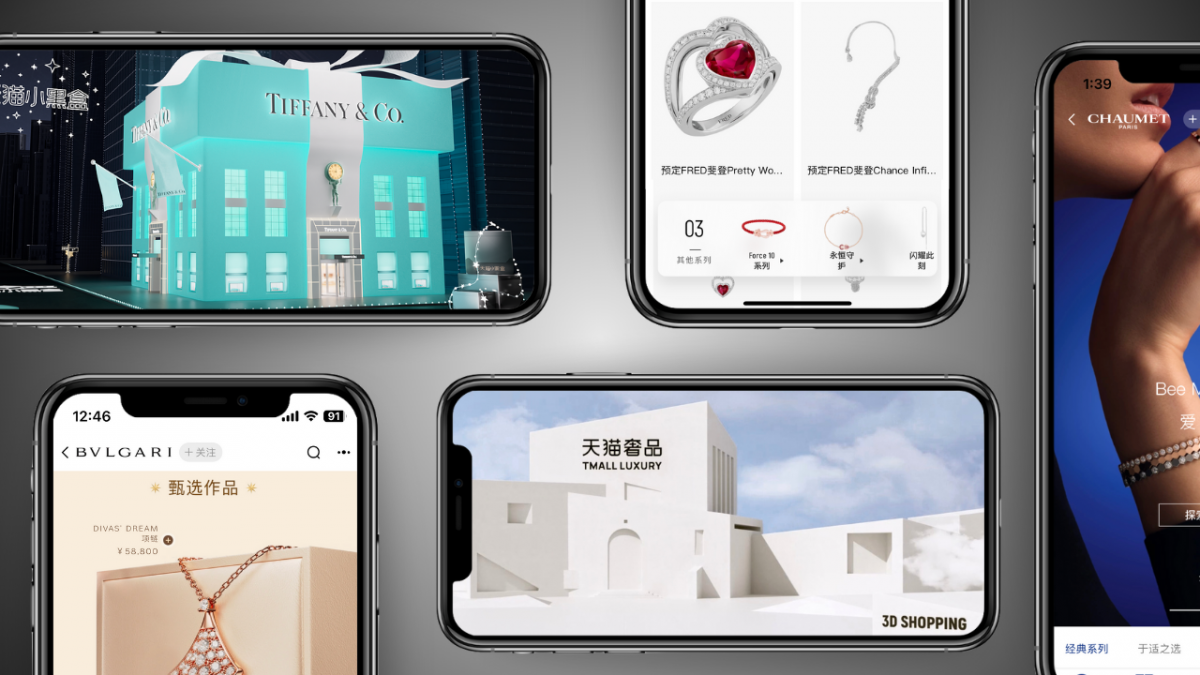
The newly released WeChat Luxury Index examines how high-end and luxury brands achieve marketing or business objectives on WeChat. The report also showcases a ranking of these brands, evaluating whether their offerings and services on WeChat are developed enough to meet the sophisticated demands of today’s consumers.
In an exclusive interview for The Luxury Society Podcast’s inaugural episode, TAG Heuer CEO Antoine Pin reveals how the brand’s historic return to Formula 1 aims to conquer new markets, seduce younger consumers, and win the ultimate battle: The one for our wrists.
At Geneva Watch Days, Bulgari’s watch managing director weighs a shrinking unit count against resilient export value, and sets out how creativity, women buyers and a disciplined reading of the secondary market could restore the balance.
At a Geneva Watch Days panel on generative engine optimisation and desirability, DLG’s Senior Advisor Antonio Carriero argued that artificial intelligence cannot originate desire, only mediate it. He explains why GEO should be treated as hygiene rather than strategy, and why the brands that win by 2030 will be both machine-legible and unmistakably human.
John Shmerler, chief executive of The 1916 Company, argues that Rolex’s Certified Pre-Owned programme has reset consumer trust in resale watches, and that the industry’s true blind spot remains what happens after the sale, not before it.