Market Share Over Market Size: Jean-Christophe Babin on Bulgari’s Record Year Amid Industry Decline
While LVMH reported declining revenues and the Swiss watch industry contracted in 2025, Bulgari CEO Jean-Christophe Babin delivered record results across jewellery, watches, and hotels – revealing why passion and market share gains matter more than market conditions.
The luxury industry ended 2025 in a state of cautious introspection. LVMH’s full-year results, released on 27 January 2026, showed revenue of €80.8 billion, representing a 1% organic decline compared to 2024, whilst profit from recurring operations fell 9% to €17.8 billion. The Federation of the Swiss Watch Industry reported export values declined approximately 1.7% year-on-year, down 4.5% from the record year of 2023. Yet within this challenging landscape, one executive stood out for his resolutely optimistic outlook: Jean-Christophe Babin, CEO of Bulgari Group and LVMH Watches Division.
In a wide-ranging conversation on The Luxury Society Podcast, Babin reveals that Bulgari achieved its best year ever in 2025 – record jewellery sales, record watch sales, record productivity per store, and record quarterly performance in Q4. This counternarrative to industry pessimism offers a compelling case study in how strategic focus can overcome macroeconomic headwinds. “As I often say to my team, whether the market will grow or not next year doesn’t matter so much,” Babin explains. “The point is that we’ll grow because we’ll gain market share.”
The Market Share Obsession
Babin dismisses widespread industry pessimism as “dramatisation,” arguing that comparisons against 2023’s post-COVID surge distort the reality of what remains historically strong performance. The year 2023 benefited from what he terms “revenge buying” – the accumulated frustration of two years during which consumers were deprived of luxury experiences whilst locked down. “During COVID, obviously, slowdown, quite important. And after COVID, a surge in demand, which was first boosted by the fact that people had been deprived from freedom,” he says. “We tend to compare ourselves logically to this year 2023, but the year 2023 had a part which was the accumulative frustration.”
His philosophy centres on a fundamental recalibration of success metrics. Rather than fretting over overall market conditions, Babin’s teams at Bulgari, TAG Heuer, Hublot, and Zenith focus relentlessly on increasing desirability through creativity, relevance, and consistency. “All our obsession is to be creative enough, to be relevant enough, to be consistent enough over time so that the desirability of Bulgari, rather than TAG Heuer, Hublot, Zenith, L’Épée are increasing in such a magnitude that despite a more cautious clients – because clients are more cautious – they will be irresistible,” he explains.
This strategy has manifested in a notable shift away from innovation-driven volume. A decade ago, up to 25% of watch industry turnover came from new product introductions. Today, Bulgari generates only 10% of sales from new releases. “Why? Because the essence of our luxury, which is most of my business, which is jewellery, is timeless,” Babin says. “And when something is timeless, you don’t necessarily need at any cost to renew it all the time.” This represents a conscious move away from fashion’s rapid collection cycles toward the permanence that defines true luxury.
The Bulgari Domvs showcasing the Bulgari Heritage Collection Credit: Bulgari
Stretching Brands Without Breaking DNA
Overseeing LVMH’s watch division – which includes TAG Heuer, Hublot, Zenith, and L’Épée – Babin has become one of luxury’s most articulate defenders of wide price architecture. TAG Heuer’s range runs from 1,800 CHF Formula 1 models to 180,000 CHF for complicated watches. At the same time, Bulgari’s collection starts from 7,000 CHF pieces from the Octo collection to over 1 million CHF for chiming watches. Critics often question whether such range dilutes brand equity, but Babin sees it differently.
“A brand can be stretched if the stretch is disciplined and consistent with the DNA,” he elaborates, referencing his tenure at TAG Heuer from 2000 to 2013 when he managed timepieces with a price range of 650 CHF to 120,000 CHF. “So no matter whether the Formula 1 costs today 1,800 CHF and a split second costs 120,000 CHF, both have the same purpose. It’s all about motor racing. It’s all about measuring fractions of times.”
The key lies in narrative coherence. Every product at every price point must serve the same brand story. “It is the same in jewellery,” says Babin. “You can find a beautiful ring at 3500 euros and you have beautiful one-of-a-kind Serpenti necklaces at 2 million euros,” illustrating how jewellery’s price span mirrors watches without damaging desirability.
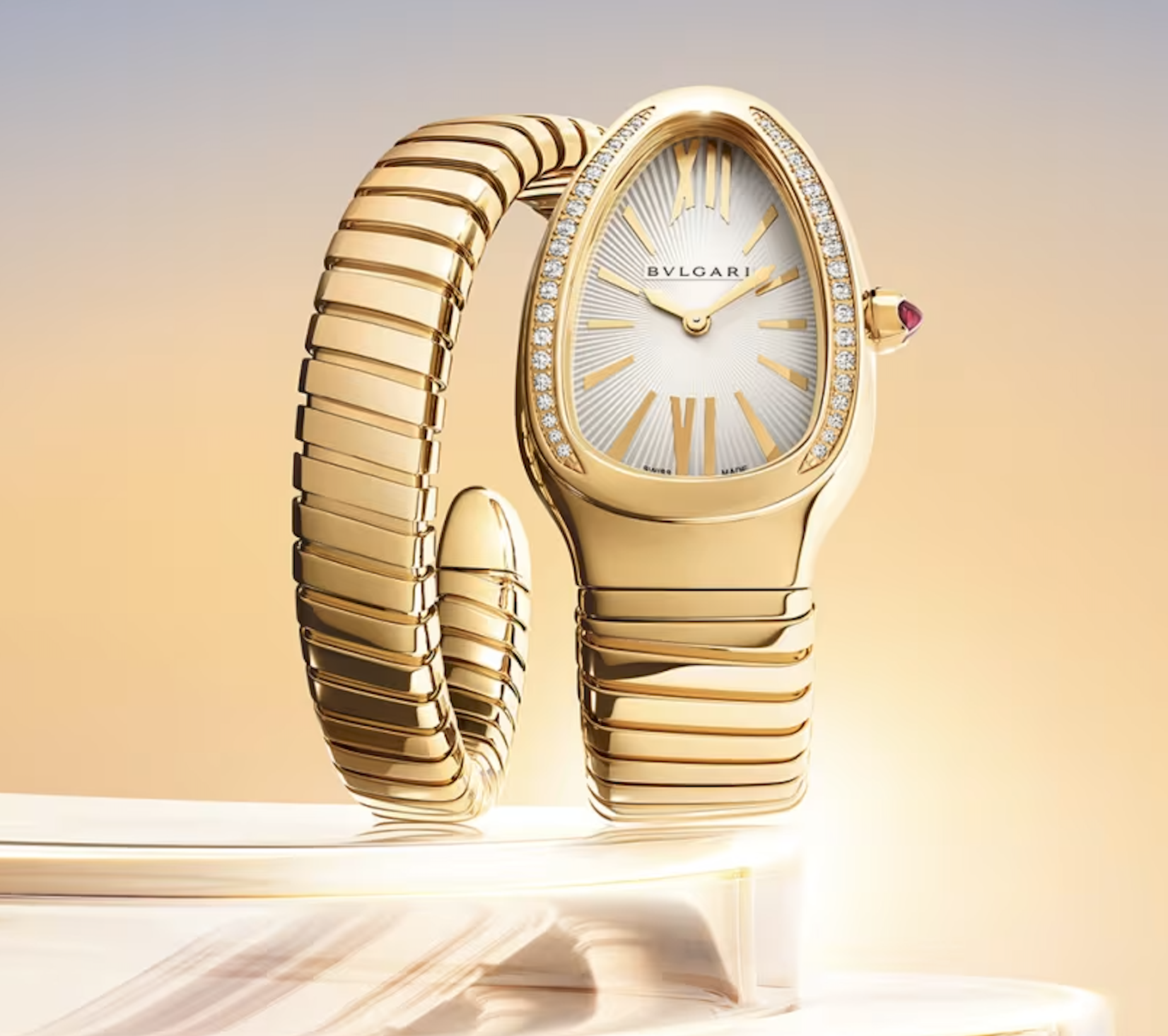
The iconic Serpenti Tubogas Watch of Bulgari Credit: Bulgari
The brand DNA preservation challenge is multiplied when a manufacture is asked to serve not only its own brand story, but the needs of an entire portfolio. This is exemplified at Zenith, where Babin notes that he is facing a “twin challenge”, the task of establishing the manufacturer as an even more efficient, superlative mechanical movement platform capable to serve different brands within the LVMH portfolio – as illustrated in the recently launched Tiffany Timer featuring Zenith’s El Primero movement – and to customise those movements. “At the same time, it needs also as a brand to grow. To provide to the manufacturer also, a substantial demand of mechanical movements,” he adds.
Addressing market rumours directly, Babin confirms: “Zenith is not for sale.” He emphasises that the brand will continue to evolve and renew itself, while remaining focused on the brand’s core pillars, the Chronomaster and Defy collections, in 2026. More recently, the manufacture’s G.F.J. (Georges Favre-Jacot) Calibre 135 won the 2025 GPHG Chronometry Prize at the 25th Grand Prix d’Horlogerie de Genève – a further nod to its rich heritage in chronometric precision which has cumulated in over 2,333 chronometry awards since its founding in 1865.
The Billion-Euro Hotel Bet
Bulgari’s nine hotels (expanding to 15 by 2030) represent perhaps the most ambitious cross-category strategy in contemporary luxury. These properties are not hospitality side projects – they are strategic weapons in the battle for market share. “We never open a unit in a city or on an island if we’re not convinced that we will be the single most expensive hotel,” Babin stated with characteristic directness.
The strategy has delivered measurable results. Bulgari hotels claimed first place in average daily rate (ADR) rankings in seven of nine locations in 2024, securing second place in the remaining two. His next target: topping Leading Quality Assurance (LQA) customer experience scores, which measured by independent mystery shopping audits. “I want to be first in price and first in LQA because I cannot be first in price and not deliver the experience at the same level,” Babin explains.
The business logic extends beyond hospitality revenues. According to Babin, approximately 90% of global luxury spending occurs in roughly 20 cities worldwide. Bulgari’s expansion strategy targets this concentration, securing presence in key wealth centres from Paris to Dubai to Beijing. “We are gradually getting to a full coverage of where the wealth is spent,” he says.
But the true value lies in engagement duration. “Our [hotel] clientele is made of independent people. Many are entrepreneurs, they don’t spend one hour in a store,” says Babin. However, in a Bulgari hotel, they spend 24 to 72 hours in what Babin calls “full immersion into the brand.” This creates fundamentally different opportunities. “The hotel is really a pool, when the boutique is a pond,” he explains. “The other brands have ponds only, we already have nine pools.”
The hotel expansion also delivers image impact that traditional retail cannot match. “Hotels are really getting to the brand status, power that nothing else could bring to the brand,” Babin says. As the only jewellery or watch brand that can host clients and events in its own properties across global locations, Bulgari has created an experiential moat that competitors will find difficult to replicate.
Bulgari Hotel in Rome Credit: LVMH
Passion as Strategy
As Jean-Christophe prepares to transition from CEO to Chairman in July 2026, handing operational leadership to his current deputy Laura Burdese, his advice reflects three decades navigating luxury’s cycles. “Build on the pillars we have been passionately putting together over those years, which have proven very competitive, very attractive, very desirable,” he counsels. “And further push the brand potential to new levels.”
His confidence stems partly from Bulgari’s unique positioning. “No brand can be inspired by 27 centuries of art and architecture,” he says, referencing Rome’s unparalleled cultural heritage. “No brand can be as welcoming as a brand born in the city of the dolce vita. Bulgari is totally unique. You cannot copy 27 centuries of history of art which are inspiring your jewellery and your style. You cannot copy the dolce vita.”
The lesson of Bulgari’s record 2025 is not that market conditions are irrelevant – Jean-Christophe faces the same gold price spikes, currency volatility, and geopolitical tensions as every competitor. Rather, it is that obsessive focus on market share gains, disciplined brand stretching, experiential differentiation, and sustained passion can overcome even severe headwinds. Beyond brand specifics, Jean-Christophe’s philosophy centres on optimistic enthusiasm in an industry prone to pessimism. When asked how he maintains energy levels while managing a vast brand portfolio, his answer is simple: “It’s very much related to curiosity and passion. Curiosity creates passion, and when you’re passionate, energy is a side benefit of passion.”
______________________
Listen to the full interview with Jean-Christophe Babin on The Luxury Society Podcast onApple,Spotify, andother major podcast platforms. Discover more insights on luxury leadership, market strategy, and the future of high-end hospitality.
Subscribe to The Luxury Society Podcast to receive notifications about new episodes featuring luxury industry leaders. Never miss an episode as we continue exploring the themes shaping the future of luxury.
Lydianne is a seasoned marketing and communications professional with over a decade of experience in the luxury industry. Having spent six years in Shanghai, she also has a deep understanding of China’s evolving luxury landscape. Currently Global Marketing & Communications Director at DLG, she previously led marketing efforts for DLG China. Before that, she honed her editorial expertise at Prestige in Singapore and later as China Editor of Luxury Society.
The newly released WeChat Luxury Index examines how high-end and luxury brands achieve marketing or business objectives on WeChat. The report also showcases a ranking of these brands, evaluating whether their offerings and services on WeChat are developed enough to meet the sophisticated demands of today’s consumers.
In an exclusive interview for The Luxury Society Podcast’s inaugural episode, TAG Heuer CEO Antoine Pin reveals how the brand’s historic return to Formula 1 aims to conquer new markets, seduce younger consumers, and win the ultimate battle: The one for our wrists.
With 34% sales growth, a younger customer base, and an unwavering commitment to sustainability, the Swedish electric carmaker is proving that challenger brands can thrive in a market dominated by legacy giants
Whilst major watch groups struggle with market uncertainty, Switzerland’s independent watchmakers are thriving – and H. Moser & Cie’s remarkable transformation reveals precisely why
As luxury watchmakers navigate uncertainty and market contraction, Hublot’s CEO outlines a strategic recalibration that trades marketing reach for emotional resonance – prioritising community cultivation and authentic experiences over sponsorship ubiquity