Max Büsser on Risk, Creativity and the Unlikely Empire of MB&F
Twenty years after founding MB&F on instinct, insufficient capital, and an unfinished sketch, Maximilian Büsser reflects on what it costs and what it takes to build a creative brand that refuses to grow up
The Swiss watch industry is navigating one of its most difficult periods since the pandemic. Swiss watch exports fell 2.8% to CHF 25.9 billion in 2024, according to the Federation of the Swiss Watch Industry, with volume brands bearing the brunt of declining consumer demand.
Against that backdrop, MB&F, a Geneva-based independent watchmaker, continues to command waitlists, collector loyalty, and critical regard. Speaking on a recent episode of The Luxury Society Podcast, MB&F founder and creative director Maximilian Büsser offers an account of how the brand came to be, why it has stayed deliberately small, and what prompted him to sell a stake in the company he built to Chanel.
Why MB&F Was Never a Business Plan
The origin of MB&F is not a story of strategic planning. It began on a plane returning from Singapore in 2003, where Büsser was sketching the outline of a watch shaped like the number eight. He was, at the time, CEO of Harry Winston Rare Timepieces, a role in which he had grown revenues tenfold – from $8 million to $80 million – and conceived the celebrated Opus series of concept watches in collaboration with independent watchmakers. He had no immediate plans to leave.
What forced his hand was a contract. A new management team, satisfied with his performance, presented him with a 25-page document that included stock options, a 12-month severance package, and, on its final page, a non-compete clause. “I finally found how I’m going to make my dream come true,” Büsser recalls. “And if I sign this contract, I’m dead.” He took a week’s holiday, modelled the cashflows, and concluded he was “clearly missing at least half the money” required. Two weeks later, at a board meeting in New York, he resigned. He had no complete business plan, no finished design, and insufficient capital. “I think you just fall in love with an idea,” he says, “and once you fall in love, you’re not very rational.”
This emotional, rather than analytical, act of founding has shaped MB&F’s creative philosophy ever since. The brand’s guiding maxim – a creative adult is a child who survived – draws on a conviction that most people abandon their creative instincts not out of inability but out of fear. Büsser cites the late Sir Ken Robinson, whose 2006 TED Talk “Do Schools Kill Creativity?” argued that education systematically suppresses the creative instincts children are born with: “All kids are creative because they’re not scared of being wrong. And I think that’s very much what defines us at MB&F. We’re not scared of being wrong.” The practical consequence is a decision-making framework grounded not in return on investment but in a longer-term measure. “Whatever you do in your business decisions or creative decisions,” Büsser explains, “they’re based on pride, meaning will I be proud of that in 10 or 20 years.” By that logic, even a failed business decision made in good faith carries no regret – while a profit-driven decision that goes wrong leaves only bitterness.
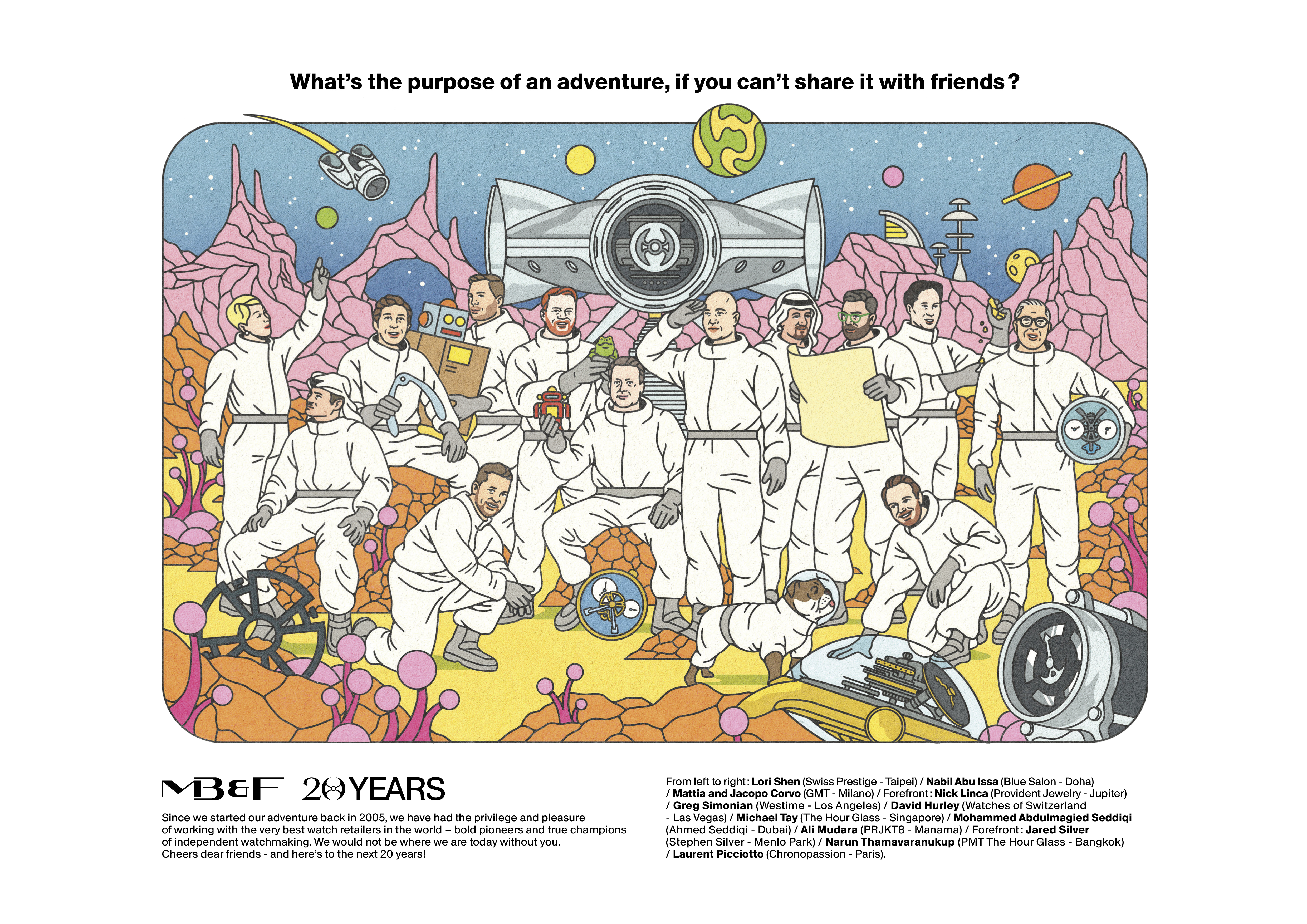
Retailers Illustration – Celebrating 20 Years of MB&F Credit: MB&F
Staying Small, Staying Sharp
Where the founding of MB&F was an act of instinct, the management of its growth has been an act of sustained discipline. The brand currently produces around 400 Horological Machine and Legacy Machine pieces per year across its wholesale and retail channels – a figure that has grown only modestly from the roughly 290 pieces it was making before the pandemic. When 2020 and 2021 brought an unexpected surge of new demand, Büsser and his team made a decision that ran counter to most commercial logic: they declined to increase production. “We took a very bold decision, that of not growing,” he notes.
Running alongside the core haute horlogerie range is M.A.D.Editions, a parallel brand with a longer and more complicated gestation than its eventual success might suggest. The idea dates back to 2014, when Büsser first conceived of creating a watch not for collectors or connoisseurs, but for his friends and family – people who simply could not afford an MB&F timepiece.Four years of engineering, trial and error led the team to an uncomfortable conclusion: the project might be impossible. In 2018, after countless dead ends, they shelved it.
It was the pandemic that brought it back. With retailers shuttered and revenues under pressure across the industry, the once-abandoned concept resurfaced during a team meeting. The framing shifted: rather than launching a new brand, the team would produce it as a finite run with no ongoing obligation. “Maybe we can call it an edition,” Büsser recalls telling his team. “An edition, you just do 500 watches, get a bit of cash, and that’s it.” The plan was to send a personal email to about 450 suppliers and long-standing collectors about this special edition – no public campaign, no social media – simply an opportunity to purchase the M.A.D.1 Blue.Three days later, images appeared on Instagram, and demand became uncontrollable. The decision was taken to produce 1,000 pieces of this timepiece, which could be purchased by members of the public through a raffle. Over 18,000 applicants signed up.
The brand now activates twice a year, for seven days at a time, via raffle only – and produces 5,000 pieces annually, according to Büsser. What began as a shelved idea, revived under duress, has become a structural pillar. MB&F’s revenue architecture now rests on three roughly equivalent streams: MB&F wholesale (approximately 300 pieces), MB&F retail (approximately 100 pieces), and M.A.D.Editions. “It gives us a third foot to stand on,” Büsser says. “Whatever happens in the world, we hope that we will therefore have three legs to stand on and we can play around to sustain our company.”
Eric Giroud and Max Büsser collaborating on the M.A.D. 2 collection. Credit: MB&F
Independence, Succession, and the Chanel Equation
In August 2024, MB&F announced that Chanel had acquired a 25% stake in the company. For a brand whose identity is so thoroughly anchored in creative independence – it is named, after all, for its founder and his friends – the announcement reads, on the surface, as a contradiction.
Büsser’s account reveals the opposite. The decision was not commercial in origin but existential, prompted by a period of personal reckoning. “I unfortunately started losing friends,” he says. “Heart attack, pancreatic cancer. I’m 59 now… And that sort of brings you to your mortality.” With children aged eight and 12 who may or may not have the inclination or aptitude to run the company one day, and a wife not involved in the business, Büsser needed to ensure that should something happen to him, his family – inheriting the majority of a company they had no part in operating – would not be in a position to sell to a private equity fund or a publicly listed group. “It needed to be a family-owned business, which has very long-term thinking and enjoys furthering craftsmanship and innovation.”
The connection to Chanel came through a conversation at Watches and Wonders 2022. “They casually said, ‘How can I help you?’ And I said, well, you’re probably not going to expect this, but I have a succession issue. And 20 minutes later, basically, we shook hands.” Chanel had made comparable minority investments in F.P. Journe in 2018 and Romain Gauthier in 2011, and Büsser had consulted both watchmakers before proceeding. “Both of them are like, ‘This is incredible,'” he notes.
The structure gives Chanel a right of first refusal on any future stake sales – functioning as a firewall against unwanted acquisition – while Büsser retains full operational and creative control. “They don’t mingle. They don’t ask for anything. And when we do, from time to time, ask for some help, they’re always there. It’s a match made in heaven.”
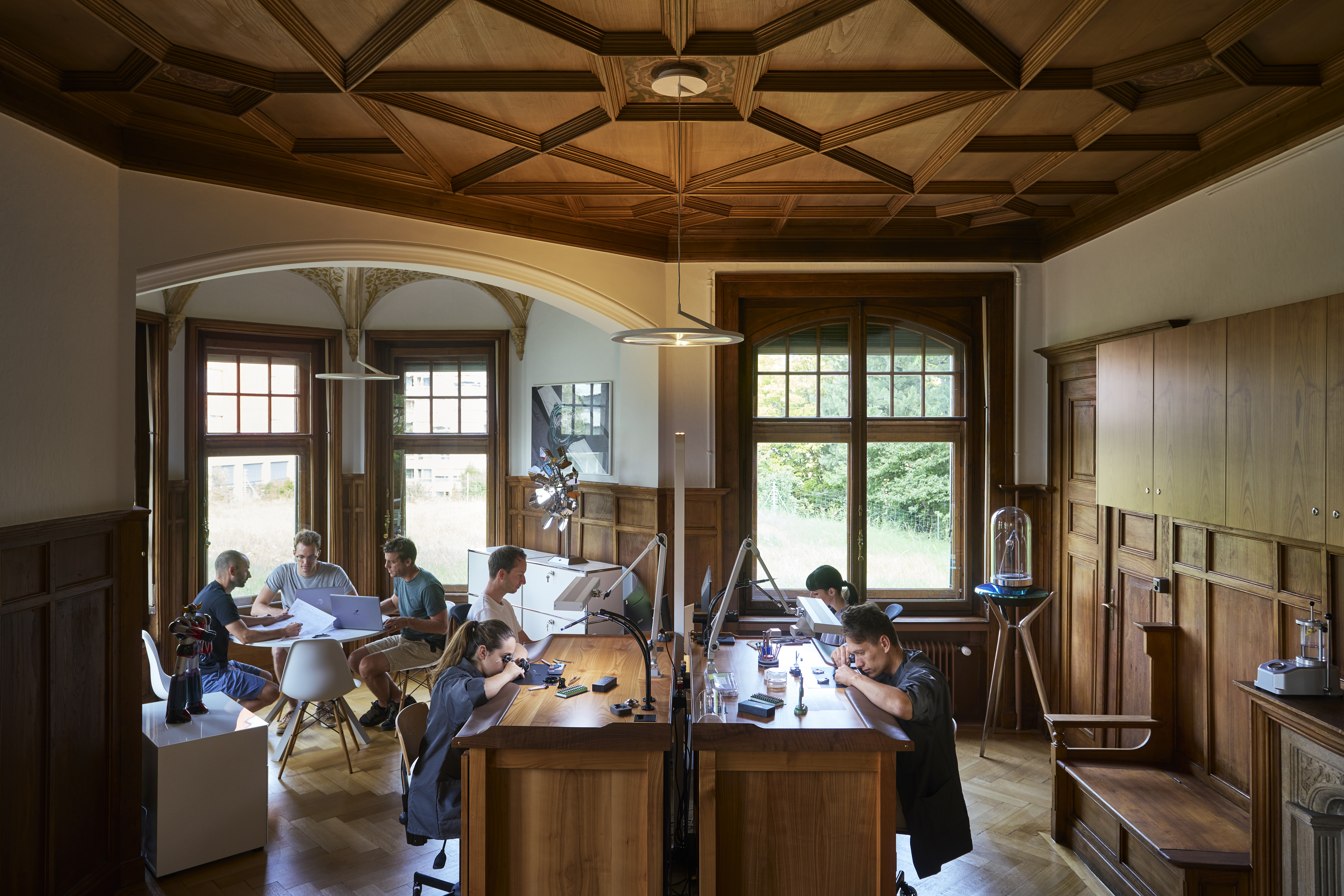
MB&F M.A.D.HOUSE – Workshop Credit: MB&F
The arrangement reflects a broader truth about what independence actually means in contemporary luxury. It is not, or not only, about avoiding institutional shareholders; it is about preserving the structural conditions under which creative risk-taking remains possible. Against a market that contracted in 2024, the watchmaking brands that continued to grow were, with few exceptions, those with the structural freedom to make long-term creative bets rather than respond to short-term commercial pressure – a theme explored in our interview with Richard Mille EMEA CEO Peter Harrison. Büsser’s succession structure, unconventional as it appears, is designed to preserve precisely that freedom for whoever leads MB&F next.
A Creative Medium, Not a Commercial Formula
Two decades in, Büsser finds himself with something he never set out to build: a stable, diversified creative enterprise that has remained stubbornly itself throughout. Yet what strikes him most about the current landscape is not what MB&F has achieved, but how much more accessible the path has become for those who come after. When MB&F launched in 2005, there was no direct-to-consumer model, no watch blogs, no social media – none of the infrastructure that today’s independents take for granted. “Typically in our industry, it has never been so easy in so many ways,” Büsser observes. Where he once spent a third of every year travelling the world to meet journalists, hoping for “a little part of a page in a print magazine that maybe nobody was reading,” a new generation of independents can reach their collectors directly and immediately – picked up by communities of enthusiasts the moment they appear. His advice is characteristically straightforward: redirect that saved energy into the work itself – into greater creative risks, bolder ideas, and the relentless pursuit of what he calls one’s true north.
Subscribe to The Luxury Society Podcast to receive notifications about new episodes featuring luxury industry leaders. Never miss an episode as we continue exploring the themes shaping the future of luxury.
Lydianne is a seasoned marketing and communications professional with over a decade of experience in the luxury industry. Having spent six years in Shanghai, she also has a deep understanding of China’s evolving luxury landscape. Currently Global Marketing & Communications Director at DLG, she previously led marketing efforts for DLG China. Before that, she honed her editorial expertise at Prestige in Singapore and later as China Editor of Luxury Society.
The newly released WeChat Luxury Index examines how high-end and luxury brands achieve marketing or business objectives on WeChat. The report also showcases a ranking of these brands, evaluating whether their offerings and services on WeChat are developed enough to meet the sophisticated demands of today’s consumers.
In an exclusive interview for The Luxury Society Podcast’s inaugural episode, TAG Heuer CEO Antoine Pin reveals how the brand’s historic return to Formula 1 aims to conquer new markets, seduce younger consumers, and win the ultimate battle: The one for our wrists.
While LVMH reported declining revenues and the Swiss watch industry contracted in 2025, Bulgari CEO Jean-Christophe Babin delivered record results across jewellery, watches, and hotels – revealing why passion and market share gains matter more than market conditions.
With 34% sales growth, a younger customer base, and an unwavering commitment to sustainability, the Swedish electric carmaker is proving that challenger brands can thrive in a market dominated by legacy giants
Whilst major watch groups struggle with market uncertainty, Switzerland’s independent watchmakers are thriving – and H. Moser & Cie’s remarkable transformation reveals precisely why