AI’s Infrastructure Moment: Why Luxury’s Data Silos Are About to Crumble
At the WEF 2026, the conversation shifted from AI principles to implementation. With DLG’s LuxuryIQ MCP, luxury brands can finally bridge the gap between fragmented data sources and strategic intelligence – transforming how they compete in an AI-driven market.
The 56th World Economic Forum Annual Meeting in Davos this January marked a turning point. Gone were the speculative discussions about AI’s potential. In their place: stark warnings from JPMorgan Chase CEO Jamie Dimon about hiring fewer workers over the next five years, juxtaposed against Nvidia’s Jensen Huang describing robotics as a “once-in-a-lifetime opportunity” that will paradoxically create more manual jobs, not fewer.
But perhaps the most telling shift was semantic. The conversation has shifted from principles to infrastructure politics – focusing not on whether AI should be deployed, but on who builds, runs, and governs the essential systems that will reshape industries. Discussions about scaling AI also captured the prevailing sentiment: moving beyond pilots to actual implementation at scale.
For luxury brands, this transition from experimentation to execution reveals an uncomfortable truth. While the industry has enthusiastically adopted AI for marketing content and creative assets – our recent research, The State of AI in Luxury, shows over 60% of luxury executives now use generative AI for these purposes – the transformative potential lies elsewhere entirely.
Credit: World Economic Forum
The Paradox of Luxury’s AI Adoption
Here’s what makes luxury’s current AI trajectory particularly striking: the functions where brands have invested most heavily deliver the lowest strategic returns, while the highest-value applications remain largely untapped.
Our study of luxury executives revealed that marketing content creation, visual design, and campaign concept development dominate current AI use cases. Yet two-thirds of these same executives identify consumer insights and analytics as AI’s top opportunity in luxury. The disconnect is glaring.
This isn’t about capability – it’s about infrastructure. The average luxury brand manages 15-30 different data sources: CRM systems, point-of-sale platforms, e-commerce backends, social media analytics, market intelligence tools, customer service logs. Each contains fragments of the complete picture, but they rarely speak to one another. A client’s social engagement lives in one system, their in-store purchase history in another, their social media sentiment in a third.
The result? Incomplete customer views, missed cross-selling opportunities, and strategic decisions made with partial information. When executives cite “data fragmentation and quality issues” as the biggest barrier to AI adoption – as 38% did in our research – they’re describing symptoms of a deeper structural problem.
Enter the Model Context Protocol
This is where the landscape fundamentally shifts. The Model Context Protocol (MCP) represents a different approach entirely to how AI systems access and synthesise information.
Think of it this way: giving Claude or ChatGPT access to proprietary luxury market data through MCP is like hiring a market analyst who happens to be fluent in every data system your organisation uses. They can pull real-time competitor performance metrics, synthesise consumer sentiment across platforms, and deliver comprehensive market intelligence – all through natural language queries.
The technical mechanism is elegant. MCP creates standardised connections between AI assistants and specialised data sources, allowing these systems to retrieve, analyse, and synthesise information on demand. For luxury brands, this means transforming siloed data repositories into a unified intelligence layer accessible through conversation.
This is precisely why we built LuxuryIQ MCP – the industry’s first luxury-specific implementation of the Model Context Protocol. Rather than expecting executives to become data scientists, we’ve leveraged this protocol to give AI assistants direct access to luxury-specific market intelligence – from brand performance metrics and consumer sentiment to competitive benchmarking and China market data. The system combines publicly available market data with DLG’s proprietary intelligence, creating a comprehensive view that isn’t available through standard AI interfaces.
Using DLG’s LuxuryIQ MCP implementation, you can ask “How was Cartier’s performance last quarter compared to our performance?” and receive not just numbers, but contextualised analysis drawing from multiple data streams simultaneously. The AI handles retrieval, cleaning, cross-referencing, and visualisation automatically.
LuxuryIQ MCP Demo Video, generating a report on brand performance in a specified market
Why This Matters Now
The timing is critical for three converging reasons.
First, the skills paradox. Our research shows 32% of luxury executives report their teams lack proper AI training, while 20% acknowledge insufficient time for upskilling programs. You need AI expertise to stay competitive, but you’re too busy to develop it. MCP-enabled systems eliminate this barrier entirely – the interface is natural language, the complexity hidden behind conversational interaction.
Second, the data recency advantage. The intelligence accessible through luxury-specific MCP implementations isn’t indexed by major language models. It represents fresh, proprietary, competitive intelligence that general-purpose AI systems simply don’t possess. This creates genuine differentiation in an era when every brand has access to the same ChatGPT interface.
Third, the democratisation imperative. When market intelligence becomes conversationally accessible, it’s no longer locked in analytics teams or executive dashboards. A marketing coordinator can query competitor positioning. A regional manager can analyse local market trends. A store director can understand customer sentiment patterns. The barrier between question and insight collapses.
The Infrastructure Question
This brings us back to Davos and that shift from principles to infrastructure. The brands that will thrive aren’t those with the most AI pilots or the flashiest generative campaigns. They’re the ones building the data infrastructure that lets AI do what it does best: synthesise vast amounts of information into actionable intelligence at the moment of need.
Consider what this looks like in practice. A brand marketing director preparing for a new campaign launch can now query with LuxuryIQ MCP: “Compare our brand performance in Europe, the Americas, and Asia versus our three main competitors over the past 18 months, and identify which product categories show the strongest momentum.” The response arrives in seconds, drawing from search demand data, social sentiment, e-commerce performance metrics, and competitive benchmarking – sources that would traditionally require multiple teams and days of coordination to synthesise.
This isn’t replacing human judgment – it’s dramatically expanding its scope. The analyst, marketer, or executive still makes the strategic call. But they’re doing so with comprehensive intelligence rather than partial visibility.
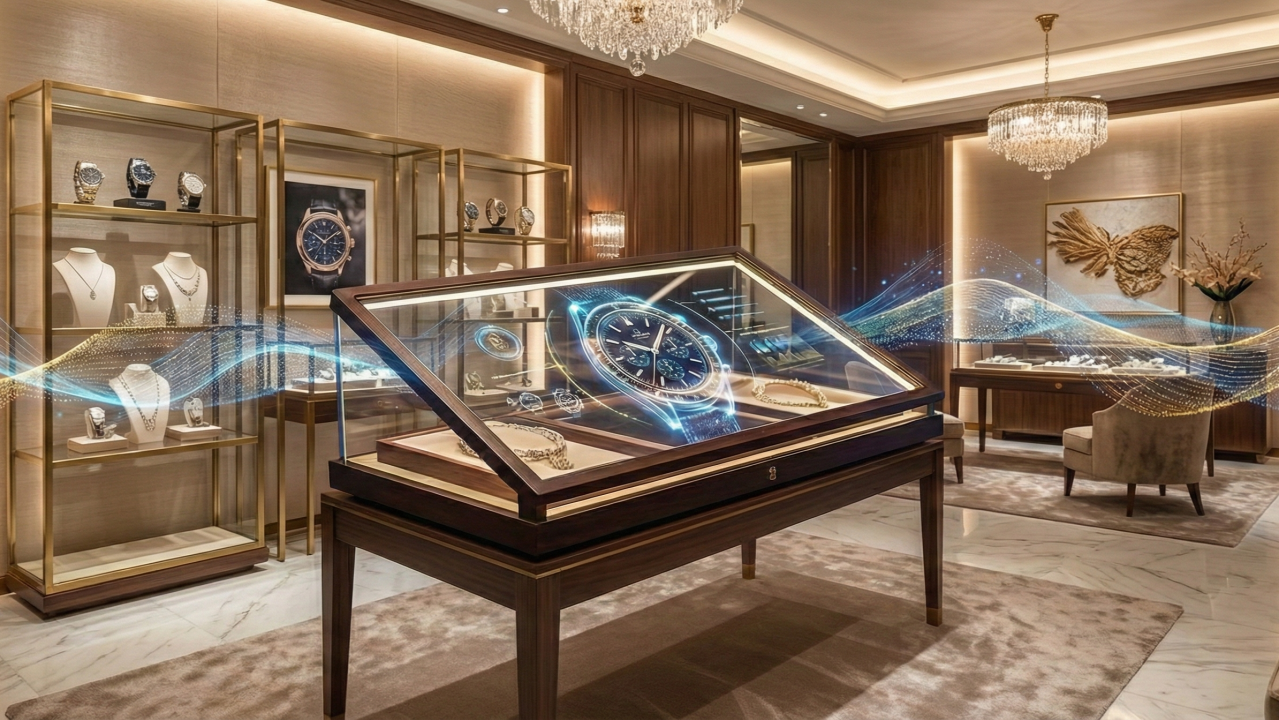
Image generated with AI
From Grunt Work to Strategic Thinking
Perhaps the most profound shift is temporal. The traditional analytics workflow – request data, wait for extraction, wrangle in Excel, build presentations, circulate for feedback – compresses from days into seconds. This isn’t simply about efficiency. It’s about fundamentally changing the questions leaders can afford to ask.
When answering a question requires a week and three teams, you ask fewer questions and make them count. When the barrier drops to conversational speed, you can iterate, explore tangents, test hypotheses, and challenge assumptions in real-time. The mode of thinking changes from conclusive to exploratory, from definitive to adaptive.
Jamie Dimon’s warning about civil unrest stemming from too-rapid AI deployment isn’t unfounded. But it also misses a crucial nuance. The disruption isn’t binary – replaced or not replaced. It’s about which functions get augmented and which get automated. The luxury industry’s opportunity lies in augmenting strategic thinking by automating data drudgery.
The Path Forward
For luxury brands navigating this transition, the imperative is clear: build the infrastructure that lets AI access your intelligence, not just generate your content.
This means investing in data connectivity before dashboard polish. It means prioritising systems integration over additional point solutions. It means treating data quality and accessibility as brand equity, not IT housekeeping.
Most critically, it means recognising that the competitive advantage won’t come from having AI – everyone will have that. It will come from having AI that knows your market, understands your competitive landscape, and can synthesise proprietary intelligence alongside industry-wide signals.
The hard part isn’t coming – it’s here. The brands that treat this moment as an infrastructure challenge rather than a feature add-on will find themselves on the right side of Davos’s emerging divide: not between those who use AI and those who don’t, but between those whose AI understands their business and those whose doesn’t.
__________________________
Pablo Mauron is Managing Partner at DLG (Digital Luxury Group), where he leads strategic initiatives in AI-powered market intelligence and digital transformation for luxury brands.
Listen to Pablo Mauron’s interview about the LuxuryIQ MCP on Episode 3 of The Luxury Society Podcast Season 3 on Apple, Spotify, and other major podcast platforms. Learn more about DLG’s LuxuryIQ MCP integration and AI-powered market intelligence capabilities or request a demo with the form below today.
Pablo Mauron is the Managing Partner at Digital Luxury Group. Based in Shanghai since 2012, his team successfully manages 360° digital and consulting projects for major luxury brands.
The newly released WeChat Luxury Index examines how high-end and luxury brands achieve marketing or business objectives on WeChat. The report also showcases a ranking of these brands, evaluating whether their offerings and services on WeChat are developed enough to meet the sophisticated demands of today’s consumers.
In an exclusive interview for The Luxury Society Podcast’s inaugural episode, TAG Heuer CEO Antoine Pin reveals how the brand’s historic return to Formula 1 aims to conquer new markets, seduce younger consumers, and win the ultimate battle: The one for our wrists.
Luxury’s traditional “white glove” service faces a digital crisis. As technology democratises personalisation, heritage brands must leverage AI and real-time data to anticipate individual needs or risk losing their premium positioning to more digitally savvy competitors.
AI promises to transform luxury, yet most brands remain stuck experimenting. The bottleneck isn’t technical capability – it’s organisational inertia. Fragmented teams, outdated structures, and misaligned metrics prevent companies from translating AI insights into action.