AI in China: The Next Great Acceleration for the Watchmaking World
While Western luxury brands debate AI strategy, China’s digital platforms are already building it for them. For Swiss watchmakers, the question is no longer whether to embrace artificial intelligence – but how to stay relevant in a market where algorithms may soon decide which brands consumers even hear about.
Artificial intelligence has become the new universal obsession – from fast-fashion trend reports to Swiss watchmaking ateliers. But as the West races to establish the rules for this technology, China is quietly writing its own script. The use cases are similar – optimising supply chains, personalising user experiences, and automating workflows – but the context is radically different. For luxury brands, and for Swiss watchmakers in particular, understanding how China’s distinct digital ecosystem will shape AI adoption may determine how they remain visible in the world’s most dynamic market.
Same Technology, Different Game
At a technical level, the ambitions are global. Every luxury group hopes to deploy AI to streamline production, personalise marketing, and capture efficiencies that human hands cannot sustain. In watchmaking, brands are already leveraging AI for trend prediction, inventory management, and procurement planning, so as to reduce over-production and waste.
Yet in China, the rules of engagement are not defined by the brands but by the platforms under mega conglomerates that host them. Crucially, they are now also the country’s leading AI laboratories, developing their own powerful large-language models – such as Alibaba’s Qwen, Tencent’s Hunyuan, and ByteDance’s Doubao – competing directly with a new wave of prolific AI startups like Baichuan and DeepSeek.
In Europe or the US, brands tend to build their own technological infrastructure or rely on a decentralised network of partners to connect a patchwork of CRM systems, analytics tools, and marketing software. In China, those layers are already provided by the platforms – and any new platform-level functionality can be rolled out to hundreds of millions of users in an instant. When Alibaba integrates its ‘Taobao Wenwen’ AI assistant more deeply into its marketplace, adoption won’t be a gradual choice; it will be an instant reality for millions.
The implication is profound: in China, AI adoption will be driven from the platforms down, not built from the brands up.
From Slow Start to Sudden Leap
Until recently, headlines often suggested China was trailing the West in generative AI, a perception fueled by the staggered release of its major models as regulators first defined how they could operate within national content and data security boundaries. But once those parameters were set, progress accelerated at a pace that mirrored China’s previous digital revolutions – from mobile payments to short-form video.
Chinese engineering teams are now noteworthy contributors to the open-source AI community, frequently publishing highly efficient models that rival Western equivalents, demonstrating a remarkable pace of development. The next phase will be defined by user adoption.
This isn’t theoretical; Chinese consumers are already interacting with AI agents like ByteDance’s ‘Doubao’ for daily queries or using sophisticated AI-powered search tools on WeChat. This rapid normalization means AI capabilities will be built directly into the applications people already use, and China’s consumer engagement curve could steepen dramatically.
For luxury brands, the result will be an audience whose first instinct is to interact with AI not as a novelty, but as a natural extension of everyday life. The way Chinese consumers discover, compare, and purchase watches is poised for another transformation, potentially faster than any previous digital shift.
The Regulatory Divide
Regulation is where China and the West start to diverge. China’s governance framework emphasises data localisation, algorithm registration, and strict content moderation. The West, by contrast, is still navigating these boundaries – while the US relies more on sectoral regulations and guidance, the EU’s approach centres on risk‑based oversight, transparency, and accountability. For global watchmakers, this means that an AI model trained in Switzerland cannot simply be mirrored in Shanghai.
Data sovereignty and compliance obligations will force brands to develop localised versions of their AI tools. Those unwilling or unable to do so may find themselves excluded from the most sophisticated consumer interfaces. This challenge is compounded by the internal hurdles of HQ-local team alignment and the significant cost of developing bespoke, compliant AI tools for a single market.
A split, however, is not the only outcome. Two distinct possibilities emerge. The first is a ‘decoupled’ ecosystem, where parallel AI tools create operational friction and cultural barriers. The second, and perhaps more likely scenario, is one where China’s AI development in consumer applications – much like short-form video – outpaces the West, setting a new global standard that Western brands must adapt to.
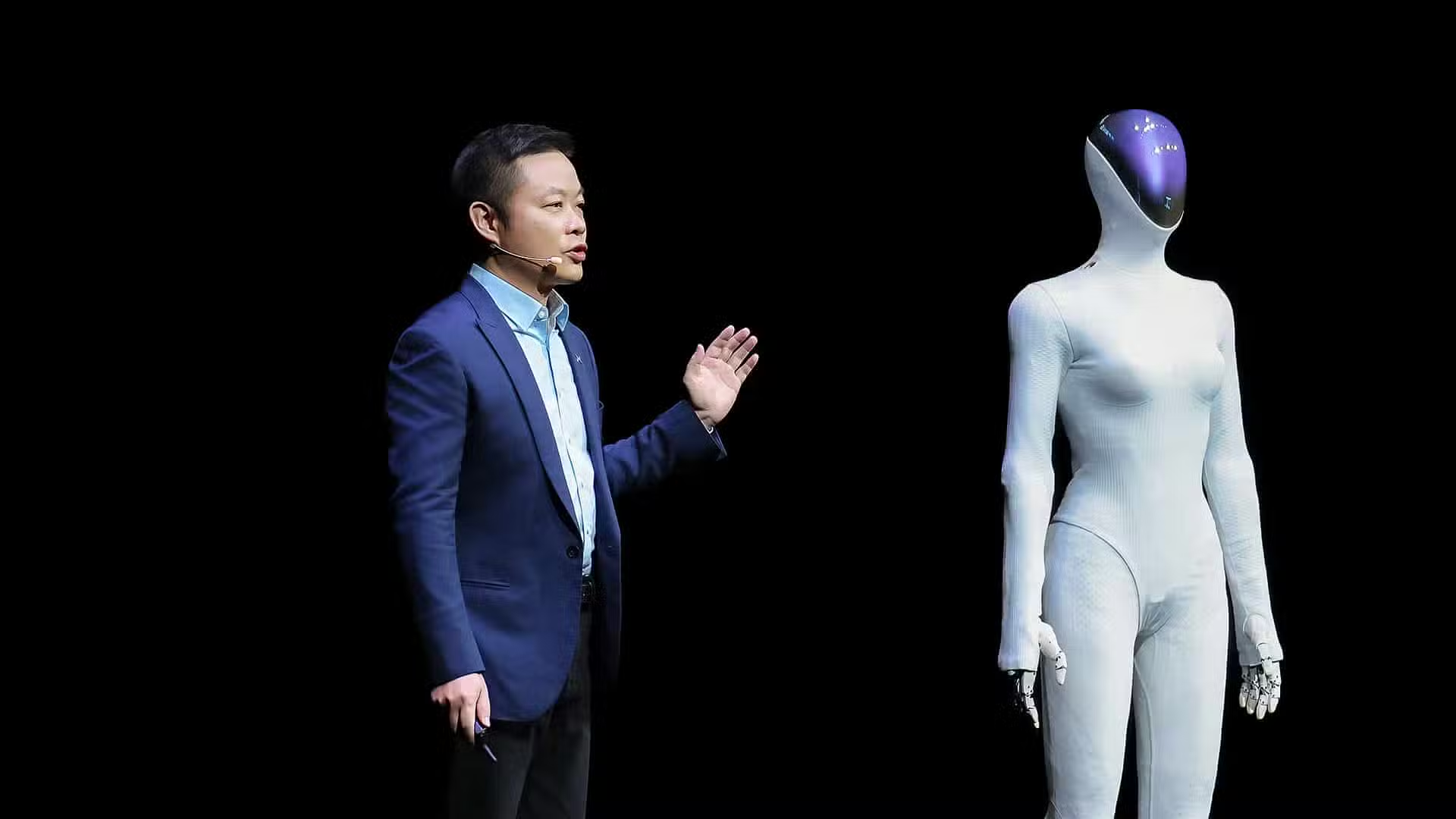
Xpeng chairman and CEO He Xiaopeng unveiling the next-generation Iron humanoid robot at 2025 AI Day. Credit: Xpeng
Lessons for the Luxury Industry
Luxury brands have long tried to establish direct-to-consumer models in China, often with limited success. The gravitational pull of platforms such as Tmall and WeChat has always proved irresistible. AI is likely to entrench that dependency. The next phase of digital commerce will not be a marketplace of pages and images but a web of conversations, many of them mediated by intelligent assistants.
When a consumer asks WeChat’s future AI companion, “Which diver’s watch suits me best?” the assistant will not open a browser; it will generate an answer, drawing from the data of participating brands. Those outside the ecosystem risk becoming invisible.
At the same time, AI presents opportunities too compelling to ignore. Image-recognition algorithms can authenticate a pre-owned Rolex or Patek Philippe in seconds, bringing transparency to the once-opaque secondary market. Predictive maintenance systems can alert a collector when a chronograph is due for service. Generative models can produce immersive heritage storytelling in fluent Chinese, marrying cultural nuance with brand integrity. Conversational agents equipped with emotional tone analysis can also offer something that luxury has always prized: empathy delivered with precision.
The promise, in other words, is not just efficiency. It is the long-awaited possibility of personalisation at scale, of creating one-to-one experiences without eroding the aura of craftsmanship that defines Swiss watchmaking.
The New Precision
Beneath the technological shift lies a subtler transformation: AI as cultural mediator. These systems do more than translate words; they interpret values, sentiment, and aspiration. For European maisons whose identity rests on heritage, this mediation is delicate. If platforms – and their algorithms – become the storytellers, who ensures that the story remains authentic?
Yet, when used intelligently, AI could amplify rather than dilute meaning. By training local models to respect brand tone and narrative discipline, while letting them express those stories through culturally resonant language and imagery, watchmakers can build deeper emotional connections with Chinese audiences in a way that static campaigns struggle to match.
Artificial intelligence is not another marketing tool to be added to a digital arsenal. It is a new operating system for how culture, commerce, and creativity interact. In the coming decade, the contrast between Western and Chinese AI ecosystems will shape how luxury brands communicate, sell, and even define themselves. For Swiss watchmaking, the challenge will be to combine traditional craftsmanship with algorithmic fluency to master a new form of precision that is linguistic and cultural, as much as mechanical.
Because in the age of AI, the ultimate expression of luxury may no longer be just keeping time; it will be understanding the person who values it, across every language, platform, and algorithm.
Pablo Mauron is the Managing Partner at Digital Luxury Group. Based in Shanghai since 2012, his team successfully manages 360° digital and consulting projects for major luxury brands.
The newly released WeChat Luxury Index examines how high-end and luxury brands achieve marketing or business objectives on WeChat. The report also showcases a ranking of these brands, evaluating whether their offerings and services on WeChat are developed enough to meet the sophisticated demands of today’s consumers.
In an exclusive interview for The Luxury Society Podcast’s inaugural episode, TAG Heuer CEO Antoine Pin reveals how the brand’s historic return to Formula 1 aims to conquer new markets, seduce younger consumers, and win the ultimate battle: The one for our wrists.
At the WEF 2026, the conversation shifted from AI principles to implementation. With DLG’s LuxuryIQ MCP, luxury brands can finally bridge the gap between fragmented data sources and strategic intelligence – transforming how they compete in an AI-driven market.
Luxury’s traditional “white glove” service faces a digital crisis. As technology democratises personalisation, heritage brands must leverage AI and real-time data to anticipate individual needs or risk losing their premium positioning to more digitally savvy competitors.